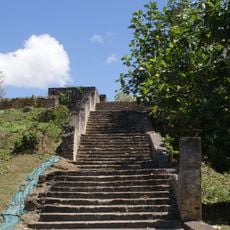
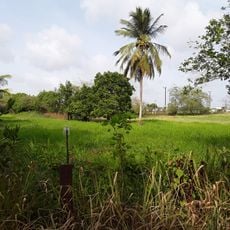
Abri Patate, Shelter in Moule (Guadeloupe)
Abri Patate is a rock shelter in the Palais-Sainte-Marguerite section of Le Moule, Guadeloupe, cut into corallian limestone of Plio-Pleistocene age. Its vault has almost entirely collapsed, leaving only a 1.5-metre overhang above a semi-circular platform about 6 metres across. The shelter sits at 35 metres altitude on a slope facing south-east, roughly 500 metres from the ocean, and its walls and ceiling carry fourteen carved anthropomorphic figures.
The shelter was found in 2003 by archaeologist Christian Stouvenot and holds carvings from the Late Ceramic Age, made between the 9th and 14th centuries. The span of use across several centuries shows that the site held importance for the local Amerindian population over a long period.
The rock face at this shelter holds fourteen carved figures showing human faces with eyes, mouths, and sometimes noses. Petroglyphs like these are rare in Guadeloupe, making this one of the few places on the island where pre-Columbian rock art can be seen directly on the stone.
Solid shoes are a good idea given the dense vegetation and uneven ground around the site. The path is not marked, so asking locals for directions before heading out will save time and effort.
The shelter's natural rock basins, which fill with fresh water in the rainy season, are rare in this arid part of Grande-Terre. Archaeologists link them to the Amerindian occupation and to the fourteen petroglyphs, dated by carbon-14 on snails brought into the shelter to between 800 and 1100 CE.
The community of curious travelers
AroundUs brings together thousands of curated places, local tips, and hidden gems, enriched daily by 93,508 contributors worldwide.