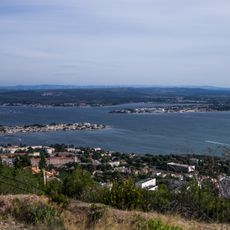
Lido de Thau, Protected area in Hérault, France
The Lido de Thau is a dune barrier on the south-east shore of the Thau lagoon, in the communes of Sète and Marseillan, separating the lagoon from the Mediterranean in the Gulf of Lion. It began forming just under 6,000 years ago from river and marine sediment between Mont Saint-Clair and Mont Saint-Loup. Shallow pools edged with rough stones and low green plants lie behind a low stone breakwater, with three pale wooden posts leaning out of the water.
The dune barrier took shape around 6000 years ago through deposits of sand and sediment moved by the sea and coastal currents. This gradual geological process created the separation between the Mediterranean and the lagoon that exists today.
The name Lido de Thau comes from the sandy barrier that closes off the Étang de Thau. The site lies across the communes of Sète and Marseillan; from Sète it is reached through the Pont-Levis district. Old salt-pan mounds now serve as nesting grounds for gulls and waders, and small islets were built for the same purpose.
You can reach this area from Sète through marked paths and walking routes designed for nature observation. The terrain is easy to navigate on foot, but sturdy shoes are helpful for sandy and sometimes damp ground.
The site's old salt-pan mounds and purpose-built islets now serve as nesting grounds for gulls and waders (Charadriiformes), a detail easy to miss from the water's edge. The Conservatoire du Littoral bought the land between 2000 and 2003, and since 7 March 2006 it has been part of the Natura 2000 network covering the Thau lagoon and its shores.
The community of curious travelers
AroundUs brings together thousands of curated places, local tips, and hidden gems, enriched daily by 93,609 contributors worldwide.