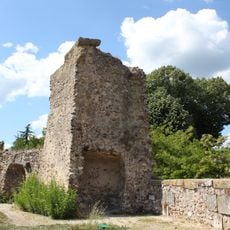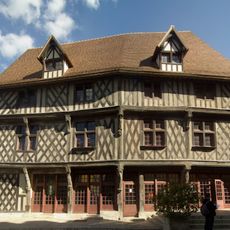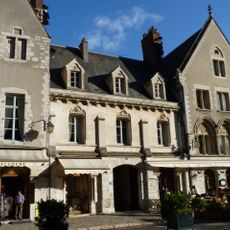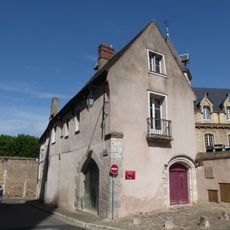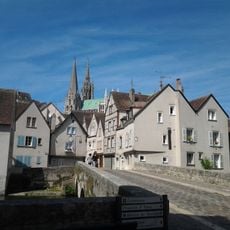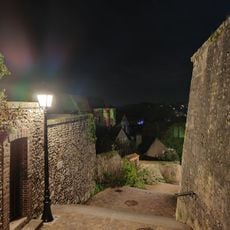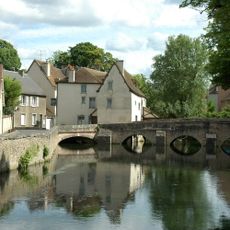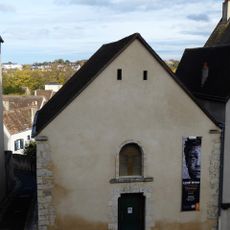
Enceinte et fortifications de Chartres, Medieval fortifications in Chartres, France
The Enceinte et fortifications de Chartres is a set of defensive works built from the Gallo-Roman era to the modern period. Its oldest element is a circular ditch about 6 km long, 10 to 20 m wide and 5 to 6 m deep, backed by a clay-and-flint rampart 1.7 km long and 4 m high. The medieval wall of the 9th century, 2 m thick and up to 13 m high, replaced it.
The fortifications began in Gallo-Roman times and were strengthened repeatedly during the Middle Ages. By the 14th century, during the Hundred Years War, they had been rebuilt with stronger stone walls to defend the city.
The name Autricum survives in the moat-and-rampart layout: a V-shaped ditch 10 to 20 m wide, dug 5 to 6 m deep, cut into eight segments of 700 to 800 m. The massive embankment behind it was built of yellow clay mixed with flint and stood 4 m high; a 1.30 m remnant was still visible in the citadel quarter in the 21st century.
The Gallo-Roman ditch ran about 6 km in eight segments of 700 to 800 m, dug 5 to 6 m deep in a V profile; the clay-and-flint rampart stood 4 m high, some 40 m from the ditch. Remains of the rampart, 1.30 m high, can still be seen in the citadel quarter. The medieval wall of the 9th century rose 13 m, 4 m of it substructions, and was 2 m thick.
The circular ditch around Autricum, about 6 km long and 10 to 20 m wide, was dug in eight segments of 700 to 800 m each, up to 5 to 6 m deep with a V-shaped profile. Dominique Joly and Hervé Sellès read it not as a defensive work but as the boundary of the city's pomerium.
The community of curious travelers
AroundUs brings together thousands of curated places, local tips, and hidden gems, enriched daily by 94,125 contributors worldwide.