Betania Monastery, Medieval Orthodox monastery in Vere River Valley, Georgia.
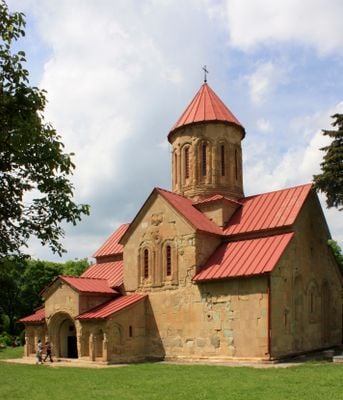
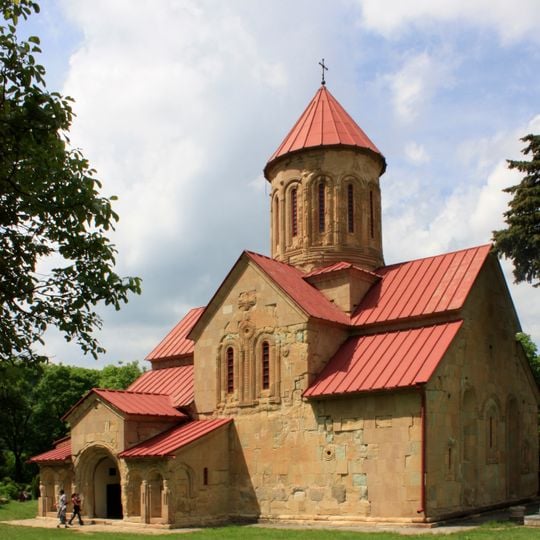
Betania Monastery consists of the domed Church of the Nativity of the Mother of God, a cross-in-square building of rectangular tan, ochre and grey stone blocks under red metal roofs, and the smaller hall church of St. George. A cylindrical drum with narrow arched windows and a conical roof rises at the crossing; the south entrance has a porch roofed with a star-shaped vault, and the eastern facade carries carved niches and an inscription panel above two arched windows.
Betania was the family abbey of the Orbeli, whose donor image of Sumbat and Liparit appears on the south transept. The main church of the Nativity of the Mother of God was built at the turn of the 12th and 13th centuries, while the small hall church of St. George dates to 1196. Restored in the late 19th century by Hieromonk Spiridon Ketiladze, it stayed unofficially active until 1963 and was reopened in 1978 under Patriarch Ilia II.
The northern wall displays rare frescoes from the 13th century showing Georgian rulers such as Queen Tamar and King George III. These images reveal how the monastery served as a place where religious and royal authority came together.
The site sits about 16 kilometers southwest of Tbilisi and is accessible from the city. Visitors should expect uneven paths around the complex and check local opening hours before planning a visit.
The monastery stands out for continuing worship, weddings, and baptisms during Soviet times when most other religious sites were restricted. This continuity of faith practices made it an exceptional witness to religious life during a period of state restrictions.
The community of curious travelers
AroundUs brings together thousands of curated places, local tips, and hidden gems, enriched daily by 93,711 contributors worldwide.