Halti, Mountain summit at Finnish-Norwegian border
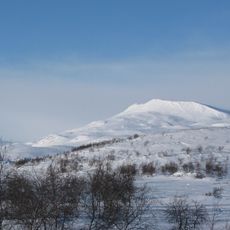
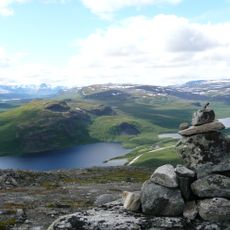
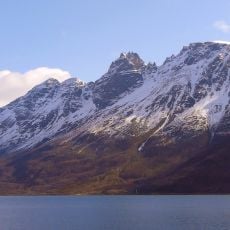
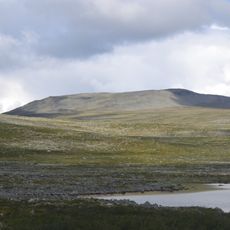
Halti is a broad, rounded fell on the Finnish-Norwegian border, its summit ridge low and undulating with no sharp peaks. Bare rocky ground in grey, brown and ochre covers the slopes, with scree below and patches of snow on the upper sections. A darker band of loose stone sweeps diagonally across its middle. The highest point, Ráisduottarháldi at 1,365 m, lies in Norway; Finland's highest point, 1,324 m, is on the slope of the Hálditšohkka spur at border marker 303B.
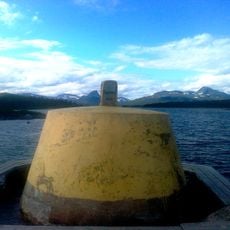
The border here follows a Swedish-Danish treaty of 1734, when Norway belonged to Denmark and Finland was part of Sweden; commissioners placed markers and drew straight lines between them. In 2015 Norwegian surveyor Bjørn Geirr Harsson proposed moving the border 200 metres to give the 1,331-metre Hálditšohkka spur to Finland for its 2017 centenary. Norway declined, citing its constitution's definition of the realm as indivisible and inalienable.
Halti has long been a sacred fell for the Sami, with several seita offering sites in the area, as Samuli Paulaharju records in "Seitoja ja seidan palvontaa". Its slopes hold some of the best lichen pastures of the fell region, and an old walking route crossed Halti between the forest areas and the Arctic coast. Many waterways of the Käsivarsi region begin near the fell.
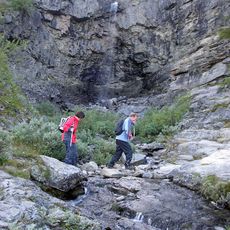
The standard hiking route starts from Kilpisjärvi and passes through varied terrain with stream crossings and rocky sections. Hikers should wear sturdy footwear and prepare for changeable weather conditions on the mountain.
In 2015 Norwegian surveyor Bjørn Geirr Harsson proposed giving the 1,331 m Hálditšohkka spur to Finland for its 2017 centenary, moving the border about 200 m. Norway's government declined, citing the constitution's definition of the realm as indivisible and inalienable.
The community of curious travelers
AroundUs brings together thousands of curated places, local tips, and hidden gems, enriched daily by 93,401 contributors worldwide.