Krapina, Neanderthal archaeological site in Krapina, Croatia
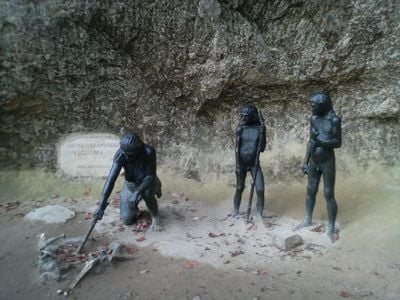
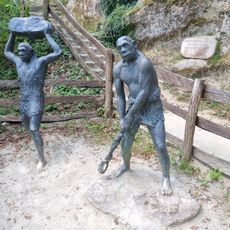
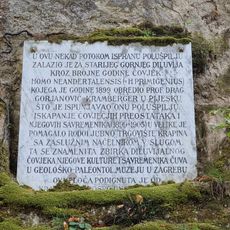
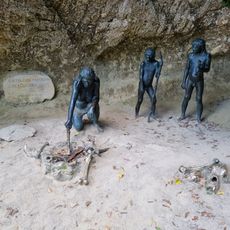
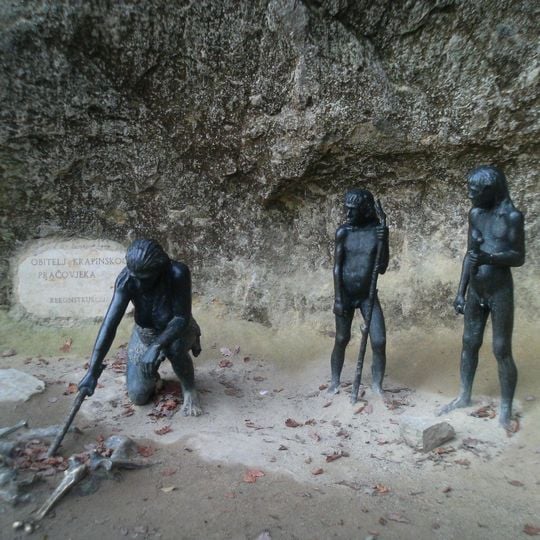
Krapina, also called Hušnjakovo Hill, is a collapsed cave in a sandstone bluff above the Krapinica River. A light stone plaque set into the rock reads "OBITELJ KRAPINSKOG PRAČOVJEKA REKONSTRUKCIJA", and in front of it stand three dark metal figures of long-haired humans: one crouches holding a stick-like tool, one stands with a vertical staff, one holds an object at its waist.
Dragutin Gorjanović-Kramberger began excavating Hušnjakovo Hill on 23 August 1899 at the invitation of friar Dominik Antolković, after workers quarrying sand found bone fragments. Over six years he recovered about nine hundred human fossil bones, stone tools and hearth remains, and published the first monographs on the Krapina Neanderthals. The finds date to roughly 130,000 years ago.
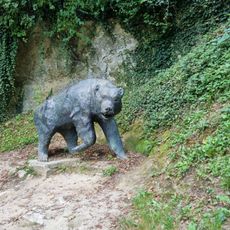
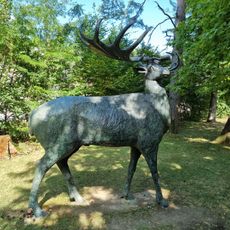
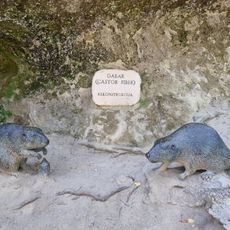
The name Hušnjakovo brdo comes from the hill above the Krapinica River where the finds were made. Since 2010 the Muzej krapinskih neandertalaca has displayed the fossils, and outside stand reconstructions of a Neanderthal family around a fire and of the animals found with them.
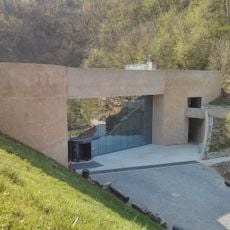
The Museum of Krapina Neanderthals, built into a small hill with a glass front, opened on 27 February 2010. Inside, a grey concrete oval atrium has a wide screen showing documentaries, and a circular ramp leads to exhibits on the upper floor. The outdoor area displays reconstructions of a Neanderthal family around a fire and of prehistoric animals.
The site yielded about 900 human fossil bones over six years of digging from 1899, the largest known collection of human skeletal remains from any Upper Pleistocene site. Among the finds were stone tools and remains of cave bear, wolf, elk, giant deer, rhinoceros and wild cattle.
The community of curious travelers
AroundUs brings together thousands of curated places, local tips, and hidden gems, enriched daily by 93,004 contributors worldwide.