St Elisabeth Church, Catholic church in District VII, Budapest, Hungary
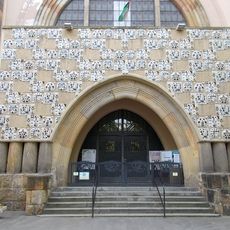
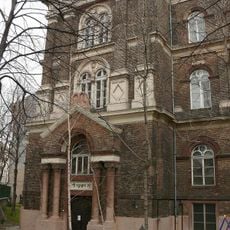
St Elisabeth Church is a Neo-Gothic Catholic church on Rózsák tere in Budapest's District VII, built from 1895 to 1901 to plans by Imre Steindl. Its two 76-metre towers flank the main entrance, and the facade combines yellow pressed brick with carved stone and Zsolnay terracotta. The interior has three naves, a transept and a hexagonal sanctuary.
The parish decided in 1889 to build a new church on the central plot of today's Rózsák tere, and Imre Steindl's Neo-Gothic design was chosen on 28 July 1892. Excavation began in July 1893 and Franz Joseph I laid the cornerstone himself on 20 October 1895. The church was consecrated on Ascension Day, 16 May 1901, and dedicated to Saint Elizabeth of the Árpád house; the earlier small church was handed to the Greek Catholic community in 1905.
The square in front of the church was renamed Rózsák tere (Square of Roses) in 1932, the 700th anniversary of Saint Elizabeth's death, after the roses that are her attribute; that year József Damkó's statue of the saint was set up there. The church was consecrated on Ascension Day, 16 May 1901, and dedicated to Saint Elizabeth of the Árpád house. The interior is deliberately plain: neo-Gothic ornamental painting by Adolf Götz, gilded wooden side altars by Mór Hölzel with biblical scenes painted by Gyula Aggházy and Lóránt Zubriczky, and a marble, onyx and bronze high altar.
The church is easy to reach on foot from the surrounding streets of District VII, and the exterior can be seen from the square at any time. Since services are held regularly, it is worth checking ahead before planning a visit to the interior.
Imre Steindl, the architect behind the Hungarian Parliament Building, designed this church earlier in his career. It is one of the few places where you can trace the early work of someone who later shaped the skyline of Budapest.
The community of curious travelers
AroundUs brings together thousands of curated places, local tips, and hidden gems, enriched daily by 92,623 contributors worldwide.