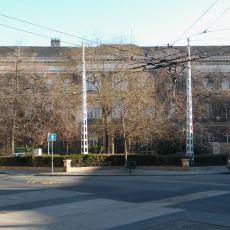
Evangelical-Lutheran Church of Budapest-Fasor, Lutheran church in Budapest District VII, Hungary.
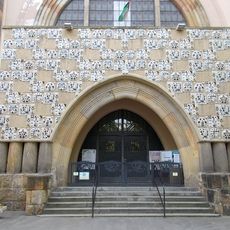
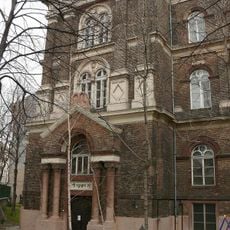
The Evangelical-Lutheran Church of Budapest-Fasor is a neo-Gothic, two-nave Lutheran church at the corner of Városligeti fasor and Bajza utca in District VII. Its 55-metre tower stands beside the main nave, and the façade alternates limestone and brick, with sculptures by Ignác Langer. Above the entrance is Miksa Róth's mosaic "Christ and the Children" and a five-metre rose window; the main nave follows the model of the Sainte-Chapelle in Paris.
In 1900 the Lutheran general assembly decided to buy land in Erzsébetváros for a new church and main gymnasium. Although Lajos Schodits won the 1903 competition, Samu Pecz received the commission; construction began that summer, delayed by strikes. The gymnasium opened in September 1904 and the church was consecrated on 7 October 1905, funded by 100,000 kronen in donations and 300,000 kronen of state support.
The church was the first Lutheran church in Budapest where services were held exclusively in Hungarian. Its name comes from the Városligeti fasor, the tree-lined avenue where it stands. The mosaic "Christ and the Children" above the entrance is by Miksa Róth.
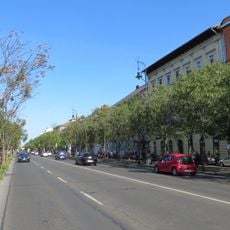
The church stands at Városligeti fasor 17–21, on the corner of Bajza utca, sharing a block with the Fasori Evangelical Gymnasium. Its main and left side facades face the street, while the choir looks onto the school courtyard. The tower rises 55 metres; the interior seats 440 and holds as many standing places, gallery included.
The two-manual organ was built by the Pécs-based Angster firm in 1906 and enlarged to 21 registers in 1989. The church's stained-glass windows by Miksa Róth were destroyed during the siege of Budapest and replaced by glass artist Miklós Kiss in 1997, 1999 and 2002.
The community of curious travelers
AroundUs brings together thousands of curated places, local tips, and hidden gems, enriched daily by 92,836 contributors worldwide.