Hall of Arts, Art museum and public building on Heroes' Square, Budapest, Hungary.
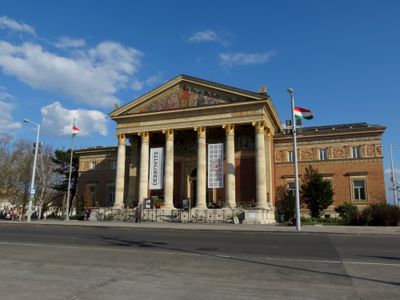
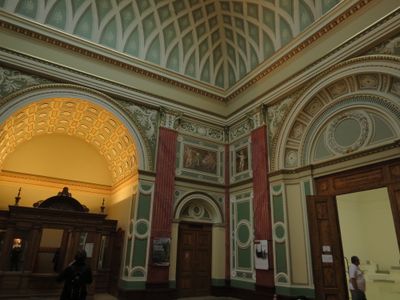
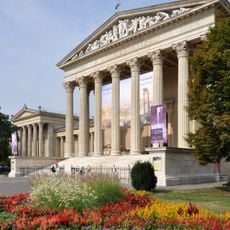
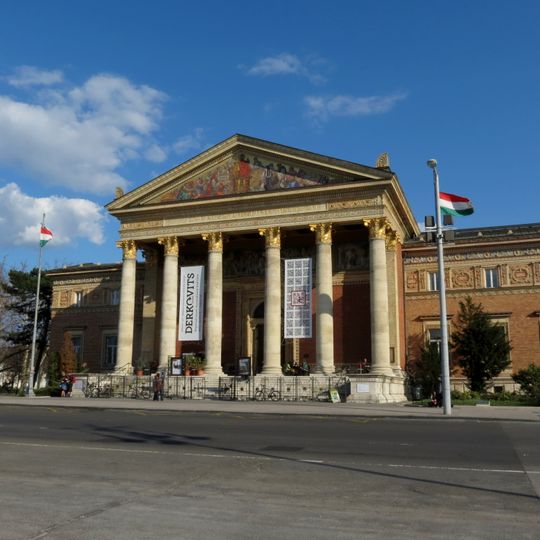
The Hall of Arts (Műcsarnok) is a Neoclassical exhibition hall on Heroes' Square, facing the Museum of Fine Arts. Its main facade has a projecting six-column portico of fluted grey stone columns under a shallow pediment, filled since 1941 with Jenő Haranghy's mosaic of Saint Stephen as patron of the arts. The long building is clad in clinker brick with a coloured ceramic frieze, and its red copper main gate was made by locksmith Pál Sátori. Inside, a three-bayed semicircular apse holds a roofed hall lit by skylights.
The Hall of Art was built in 1895–96 for the millennium celebrations of the Hungarian conquest, to designs by Albert Schickedanz with Fülöp Ferenc Herzog. It was restored under László Borsos in 1949–50 after Second World War damage, and again between 1991 and 1994. On 16 June 1989 Imre Nagy and his fellow martyrs were laid out on its steps before reburial.
The museum presents temporary exhibitions of contemporary visual art and functions as a space for artistic dialogue and experimentation. Visitors experience how the institution engages with both established and emerging artistic voices.
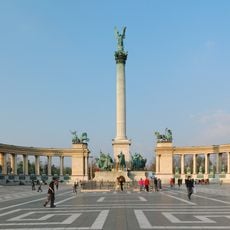
The entrance portico faces Heroes' Square, opposite the Museum of Fine Arts, and the building sits at the end of Andrássy Avenue near City Park. Inside, a bookshop, a library and the Műcsarnok Café overlooking the square are available to visitors. The roofed exhibition hall in the semi-circular apse is lit by skylights.
On 16 June 1989, Imre Nagy and his fellow martyrs were laid out on the steps of the Hall of Art before their reburial, a ceremony that drew a crowd of hundreds of thousands. The red copper main gate was made by locksmith Pál Sátori, and a coloured ceramic frieze runs around the brick-clad building.
The community of curious travelers
AroundUs brings together thousands of curated places, local tips, and hidden gems, enriched daily by 93,446 contributors worldwide.