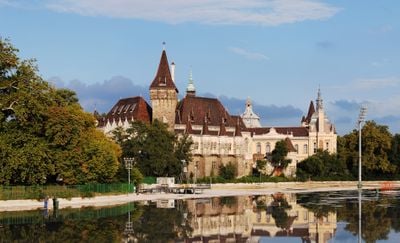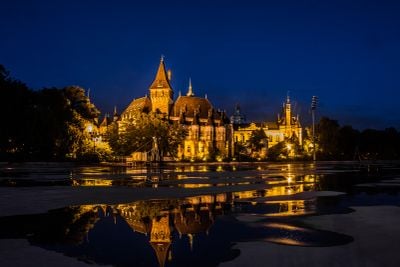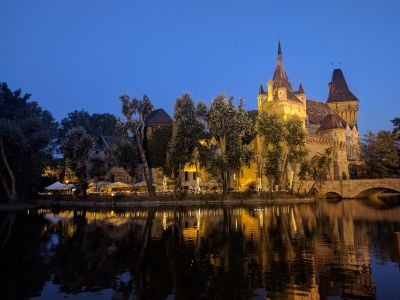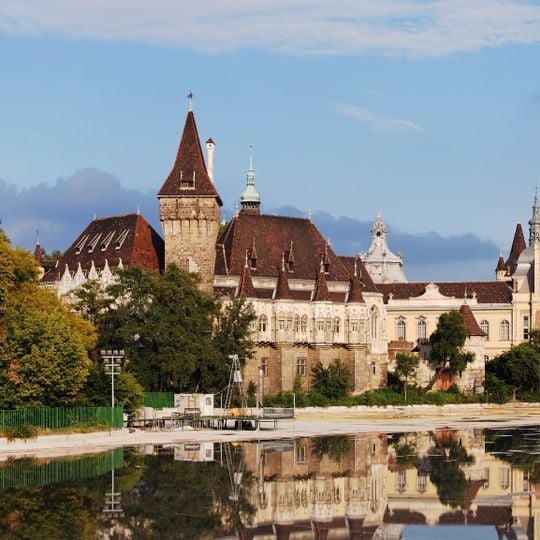
Vajdahunyad Castle, Gothic castle in City Park, Budapest, Hungary.
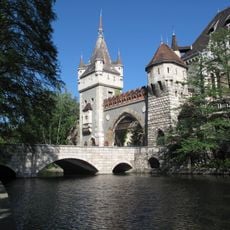
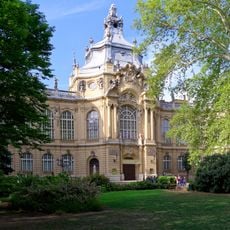
Vajdahunyad Castle, officially the Historical Building Group, was designed by Ignác Alpár and stands on Széchenyi Island in the City Park lake, reached by four bridges. Its pavilions copy landmark buildings from across the medieval Kingdom of Hungary in Romanesque, Gothic, Renaissance and Baroque styles. The main block is a reduced copy of Hunyad Castle in Transylvania, with a tall square tower under a steep pyramidal roof, pointed gables, a slender green cupola and a Gothic chapel.
The castle was built in 1896 to mark Hungary's millennium celebration, starting as a temporary wooden structure. It was reconstructed in stone between 1904 and 1908 and became the permanent form seen today.
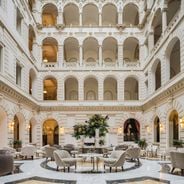
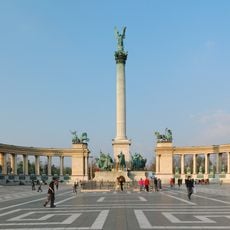
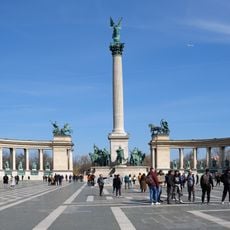
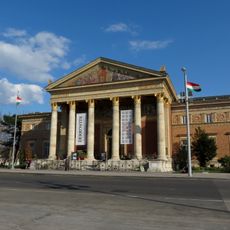
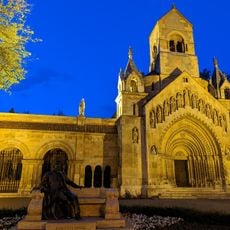
The castle's name comes from the Hunyadi family's castle in Transylvania, whose facade facing Heroes' Square was copied for the main elevation. The Jáki Chapel, consecrated in 1915, is a working Roman Catholic chapel where Mass is held every Sunday and weddings and concerts take place. The courtyard hosts concerts on its stage.
The complex sits on Széchenyi Island in the City Park lake and is reached by four bridges. The Jáki Chapel, consecrated in 1915, holds Mass every Sunday and is also used for weddings and concerts. The gate's portcullis is only imitated and cannot be lowered.
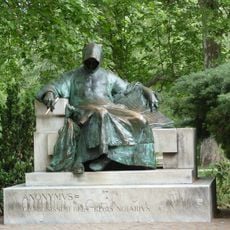
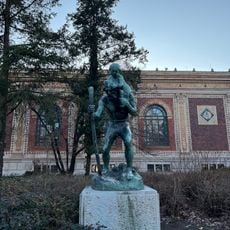
The statue in the courtyard depicts Anonymus, the unnamed chronicler at the court of King Béla III (r. 1172–96), carved by Miklós Ligeti. The figure is shown hooded, his face hidden, a reference to the chronicler whose name was never recorded. A bust of Béla Lugosi, the Hungarian-American actor who played Count Dracula in the 1931 film, is set into the castle's outer wall.
The community of curious travelers
AroundUs brings together thousands of curated places, local tips, and hidden gems, enriched daily by 92,626 contributors worldwide.