Petőfi Csarnok, Concert hall and theatre in Városliget, Hungary
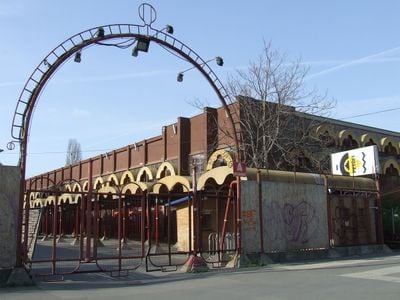
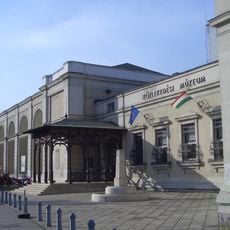
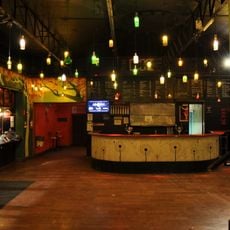
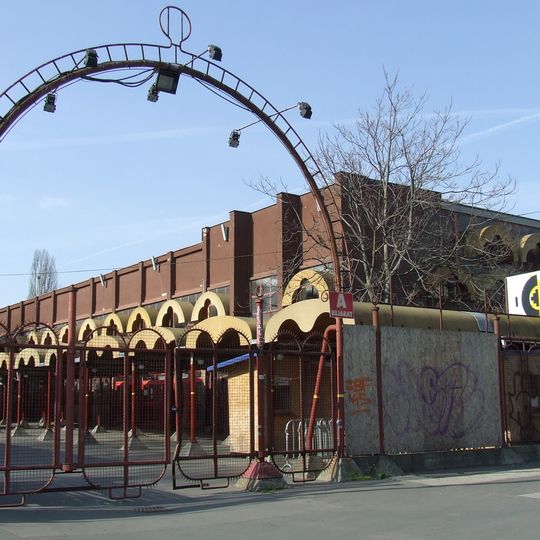
Petőfi Csarnok was a long, low hall in Városliget with a reddish-brown facade and a row of arched openings along the front. Its 930 m² main hall held about 2,500 standing or 1,200 seated, and an outdoor stage with a steel-framed canopy took 5,000–6,000. The bare concrete walls kept the marks of the formwork boards, set against red doors painted with bird-and-flower motifs.
The Petőfi Csarnok opened on 27 April 1985 with a concert by the band Karthago, in a pavilion of the former Budapest International Fair built in 1947 on the foundations of the 1885 Iparcsarnok, whose burnt-out roof was demolished after World War II. Architects Halmos György and Tihanyi Judit redesigned the empty hall, and its ornamentation was drawn by Somogyi Gábor and Buczkó György. It closed on 23 October 2015 and was demolished in 2017.
The name refers to Sándor Petőfi, the 19th-century Hungarian poet and revolutionary. The nickname PeCsa came from the initials of Petőfi Csarnok. The building hosted the Csillagfény disco, and its final event on 23 October 2015 was a last Csillagfény disco before a closing programme on 24–25 October.
The building stood in the Városliget, on the footprint of the 1885 Iparcsarnok and its 1947 fair pavilion successor. Its 930 m² main hall held about 2,500 standing or 1,200 seated, while the open-air stage took 5,000–6,000. A flea market ran beside the open-air stage every weekend.
This building held a special role as a youth culture center in Budapest, drawing artistic communities who performed there on a regular basis. It was a gathering place where experimental and traditional art forms were shown side by side.
The community of curious travelers
AroundUs brings together thousands of curated places, local tips, and hidden gems, enriched daily by 92,724 contributors worldwide.