The türbe of Idris Baba, Ottoman mausoleum in Pécs, Hungary.
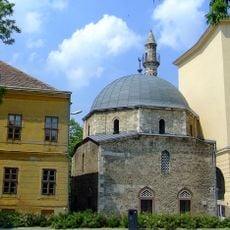
The türbe of Idris Baba is a mausoleum with an octagonal floor plan, rough stone walls, and square windows topped by pointed arches, crowned with a hemispherical dome. The structure exemplifies late 16th century Ottoman burial architecture in its proportions and construction details.
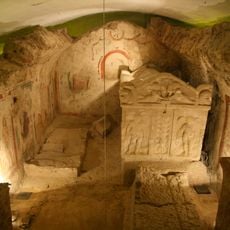
The octagonal stone türbe was built in 1591 on the southern slope of Rókus Hill, where a Turkish cemetery lay during Ottoman rule. In 1693 the Jesuits converted it into a chapel dedicated to Saint Roch, the patron of plague victims, and the hill took its present name from him. It later served as a powder magazine, was restored and partly opened in 1912, and regained its function as a türbe in 1961 after Idris Baba's rock-cut grave was opened and a skeleton facing Mecca was found.
Muslims, including Turks, come here on pilgrimage (ziyaret) to the grave of Idris Baba, a 16th-century veli, a holy man close to God, who was famed as a healer and held to be an intercessor. He is said to have been on friendly terms with Telli Hasan, the Bosnian pasha. The grave was opened in 1961 and his skeleton, turned toward Mecca, was found in the rock-cut tomb.
The türbe stands in the garden of the Pécs Children's Hospital on Rókusdomb hill and can be visited on weekday mornings. It is one of only two türbes surviving in Hungary, the other being the tomb of Gül Baba in Budapest.
The tomb is one of only two türbes surviving in Hungary, the other being the tomb of Gül Baba in Budapest. Both are pilgrimage sites for Muslims, and among them Turks, who come for the pious grave visit called ziyaret. Idris Baba was held to be a widely known healer and an intercessor, and his rock-cut grave was opened in 1961, when his skeleton was found turned toward Mecca.
The community of curious travelers
AroundUs brings together thousands of curated places, local tips, and hidden gems, enriched daily by 92,638 contributors worldwide.