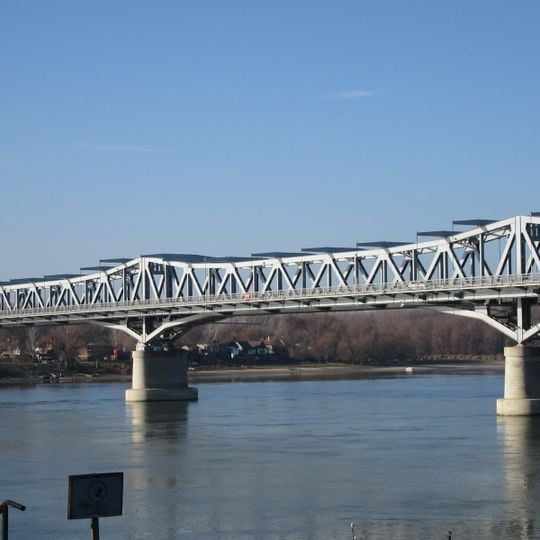
István Türr Bridge, Road-rail bridge in Baja, Hungary.
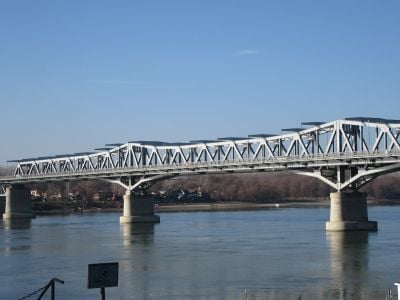
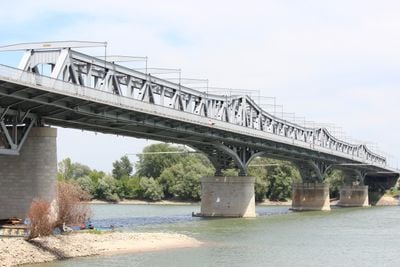
The István Türr Bridge is a metal truss bridge at river kilometre 1480.22, carrying road and rail traffic across the Danube at Baja. It consists of a four-span riverbed section and a three-span floodplain section, with a navigable opening 60 metres wide and clearance heights of 8.71 metres on the left and 8.40 metres on the right. The steel deck rests on massive concrete piers, with curved arches connecting the trusses to the pier tops.
The first bridge was built in 1908 and was a major transport project for the region. After its destruction in 1944 during World War II, it was rebuilt in 1950 to restore essential transport connections.
The bridge is named after István Türr, a native of Baja. On 1 November 1921 the last Hungarian king, Charles IV, boarded a ship at the left-bank bridgehead here and left for permanent exile. The town also calls it simply the Baja bridge.
The bridge stands at Danube kilometre 1480.22, where the navigable opening is 60 metres wide and clearance is 8.71 metres on the left bank and 8.40 metres on the right. It combines a four-span riverbed section with a three-span floodplain section, so the crossing is longer than the river channel alone suggests.
Steel from the bridge sunk in the Danube in 1944 was reused far away: 70% of the steel in the road bridge over the Hernád between Gibárt and Encs, designed in 1949 by Sándor Jakab and József Kopácsi, came from the Baja bridge.
The community of curious travelers
AroundUs brings together thousands of curated places, local tips, and hidden gems, enriched daily by 92,652 contributors worldwide.