Town Hall, Town hall and château in Baja, Hungary
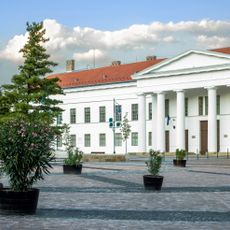
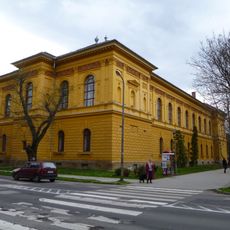
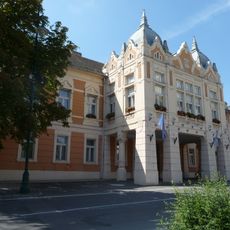
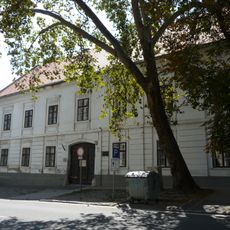
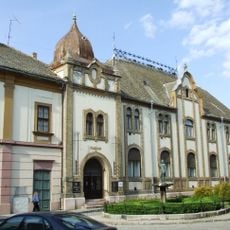
The Town Hall of Baja, the Grassalkovich Palace, is a one-storey building standing alone on a large square, with a perfectly symmetrical facade and the main entrance in the middle. Above it, on the first floor, is a small balcony. The building forms a square along the sidewalks around an inner courtyard, where open-air concerts are held in summer. The 1897–1898 reconstruction by city engineer Jeney Mihály gave it a French neo-Renaissance look: a half-round gable field above the attic bears the town coat of arms with a winged turul figure on top, and the balcony columns were replaced by Atlas and caryatid statues.
Archbishop Gábor Patachich of Kalocsa built the palace in 1744–45 on the site of the Billard house, destroyed in the fire of 24 April 1742. After his death his brother Lajos sold it, and in 1750 it passed to the Grassalkovich family. A fire on 1 May 1840 ruined the roof; the Horváth family rebuilt it in classicist style. Baja bought the palace in 1862, and in 1897–98 it was rebuilt in French neo-Renaissance style to designs by city engineer Mihály Jeney.
The building carries the names of its successive owners: Patachich, Grassalkovich, Horváth, Viczay and Zichy-Ferraris. In the stairwell turn a stained-glass window shows the coat of arms granted to the town by Leopold I, with Adam and Eve beneath the apple tree. In the great hall hang portraits of Lajos Kossuth and István Türr, and since 1978 János Szurcsik's fresco series Weekdays-Holidays.
The town hall stands alone on a large square, with a perfectly symmetrical facade and the main entrance in the middle. The building forms a square around an inner courtyard, where open-air concerts are held in summer. As it is still Baja's working municipal office, visitors should view the exterior and courtyard rather than expect access to offices.
The red marble fireplace carved with the coat of arms of Count Grassalkovich I Antal once stood on the half-landing of the staircase; it is now kept in the Türr István Museum. The staircase turn also holds a stained-glass window showing the town's coat of arms granted by Leopold I, with Adam and Eve beneath the apple tree.
The community of curious travelers
AroundUs brings together thousands of curated places, local tips, and hidden gems, enriched daily by 92,651 contributors worldwide.