Peace Stupa Zalaszántó, Buddhist stupa in Zalaszántó, Hungary
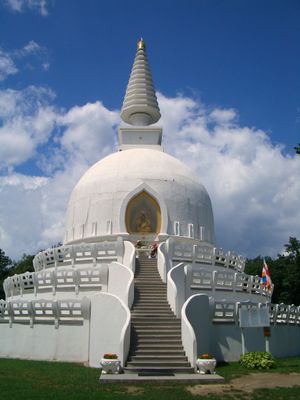
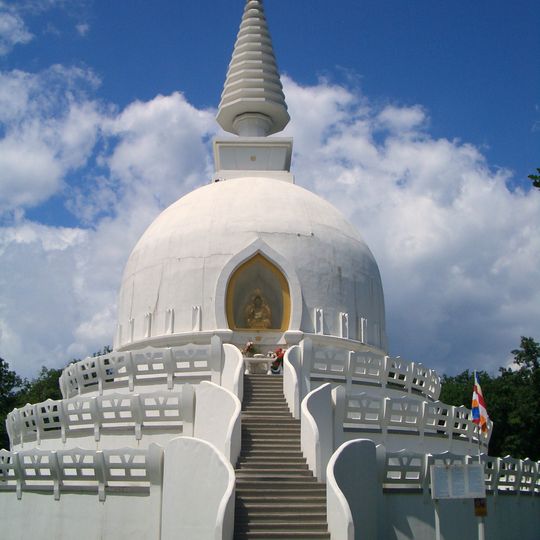
The Peace Stupa Zalaszántó is a white, southeast-facing structure 30 m tall and 24 m wide on Kovácsi Hill above the village. A grey staircase climbs between white railings to a gold-framed niche holding a golden figure; above the dome a square block carries a tapering conical spire with stacked rings. Its stepped base allows clockwise circumambulation on three levels, and the interior is closed.
The South Korean monk Bop Jon proposed a peace stupa in 1990; mayor Huszti Zoltán Ferencz offered the Világosvár site on Kovácsi Hill. Built from March to September 1992 for about 40 million forints with South Korean, Hungarian and Austrian donations, it was consecrated by the 14th Dalai Lama, Tendzin Gyaco, on 17 June 1993. Weathering led to a 2007 renovation and reconsecration, when the meditation centre was added.
The three terraces of the base stand for the four foundations of mindfulness, the four right efforts and the path to the four powers. Prayer wheels line the stupa wall on the third level, and pilgrims walk clockwise three times, often on successively higher tiers. The hilltop is called the Park of Human Rights, and colourful prayer flags are strung across the grounds.
The access road branches off at the end of the village toward Sümeg, marked by large signs; it is a poor-quality dirt track through orchards and weekend houses, so continue on foot. The stupa lies about 3 km beyond the village edge, and the climb up the gravel hill is steep. A bus from the village centre stops nearby.
The square block above the dome stands for the dwelling of the gods at the summit of the world; the tapering spire is the element of fire, and its stacked rings mark levels of enlightenment. Prayer wheels line the stupa wall on the third terrace, where the clockwise circuit is made.
The community of curious travelers
AroundUs brings together thousands of curated places, local tips, and hidden gems, enriched daily by 92,612 contributors worldwide.