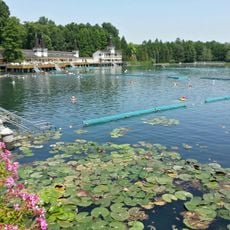
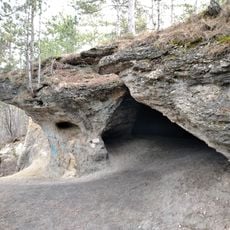
Hévíz Springcave, Natural cave at thermal lake in Hévíz, Hungary.
Hévíz Springcave opens on the wall of the spring crater 38 m below the surface of Lake Hévíz. Behind a narrow, debris-strewn mouth lies the Amphora Chamber, a hall 14 m high and 17 m across, split by a mud saddle at 40–41 m. The 38.8 °C water leaves through the entrance at 30,000–40,000 litres per minute.
The first map of the lake, made in 1769, does not show its present outline. Between 1864 and 1869, while the lake baths were built, the Keszthely architect Antal Hencz surveyed the lake and found it 43 m deep. In 1907 Károly Jordán took bottom samples and suspected a spring cave; in January 1908 a diver of the Royal Hungarian Maritime Authority, sent at Lajos Lóczy's request, reached only 22 m but found fissures discharging water. That year three divers from Fiume took water samples at 12 and 8 m, Hungary's first cave-research dives.
The cave's crater is called the Amphora Hall, named by the Amphora Diver Club, whose five researchers led by István Plózer entered it in 1975 on a VITUKI commission. The cave also appears in literature as the Plózer István Cave, after that diver. Marcasite nodules up to 5–6 kg, polished by moving sand, lie around the hot water outlet.
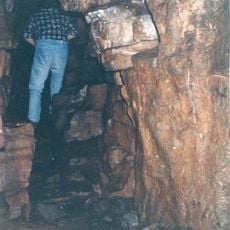
The cave entrance lies 38 m below the lake surface, reachable only by technical cave diving; the 1975 Amphora Diver Club survey had to overcome a 30,000–40,000 litre-per-minute outflow at 38.8 °C through a 2–3 m wide, 0.6–0.8 m high gap. The main chamber is 14 m high and 17 m across, split by a mud saddle at 40–41 m. West of the crater, tubular passages with 15–20 cm of floor mud were entered for 25, 17 and 15 m.
The two water layers have different origins: the cold water dates back about 8,000 years, while the hot medicinal water is at least 12,000 years old. These separate sources mix beneath the surface and create the lake's distinctive thermal conditions.
The community of curious travelers
AroundUs brings together thousands of curated places, local tips, and hidden gems, enriched daily by 92,607 contributors worldwide.