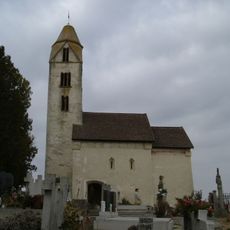
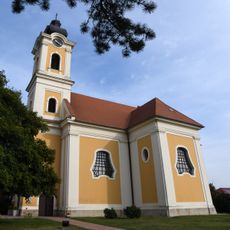
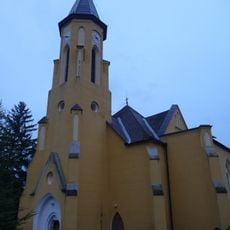
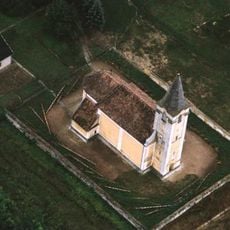
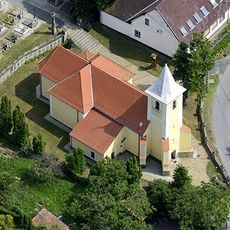
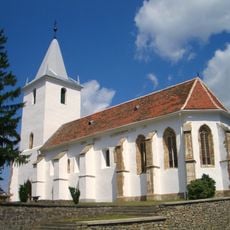
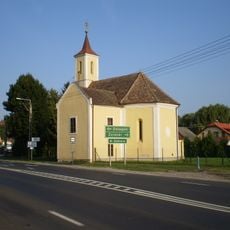
Our Lady of Hungary church in Keszthely, Gothic Catholic church in Keszthely, Hungary.
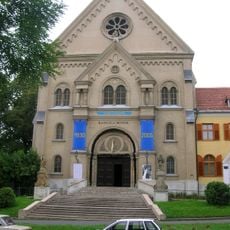
Our Lady of Hungary church in Keszthely stands on the main square and is the town's oldest surviving building. It has three parts: a neo-Gothic 19th-century tower and porch, the nave, and a sanctuary closed on three sides of an octagon. A monastery, cloister and sacristy adjoin it to the north, the Saint Anne chapel to the south.
Franciscans arrived in Keszthely in 1385 and began building the church and adjoining monastery the following year; archaeologists found an older chapel on the site in 1957. The church was built in stages, the sanctuary and sacristy older than the nave, and around 1390 it was completed for István Lackfi, executed in 1397 and buried here; his worn red marble tombstone is set in the sanctuary wall. In the 1550s it was rebuilt as a fortified structure during the Turkish wars. The Franciscans returned in 1723 and rebuilt it, adding the Saint Anne chapel; expelled in 1788, they saw the monastery become a barracks. György Festetics acquired the church in 1799 and made it the town's parish church, bringing Premonstratensians. The neo-Gothic tower was built in 1878, the church rebuilt in 1896, damaged by fire in 1904 and restored then and in 1970; the tower was largely destroyed in 1945.
The Gothic frescoes inside, rediscovered in 1974, are the largest surviving Gothic frescoes in Hungary; despite their fragmentary state they form one of the country's most complete known sanctuary decorations. The church is dedicated to the Virgin Mary as Patroness of the Hungarians, and its feast day is held on 8 October. A mosaic of Saint Mary with Jesus sits above the main door.
The building is easy to reach on foot and can be viewed from outside with clear architectural features visible. The interior is best visited during daylight hours to appreciate the frescoes and architectural details clearly.
The red marble gravestone of István Lackfi, palatine of Hungary and executed in 1397, is set into the wall of the sanctuary; it is heavily worn. His equestrian statue stands in front of the church, erected for the millennium. The neo-Gothic tower of 1878 received the original 14th-century rose window from the west gable.
The community of curious travelers
AroundUs brings together thousands of curated places, local tips, and hidden gems, enriched daily by 92,654 contributors worldwide.