Nike-statue, Monumental sculpture in Pécs, Hungary.
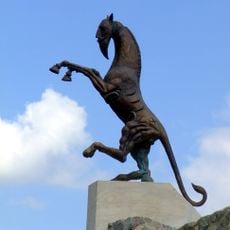
The Nike-statue is a monumental sculpture made of copper and concrete in Pécs that depicts the Greek goddess of victory in an unusual form without head or arms. The structure conveys dynamic movement despite these missing parts, expressing the concept of triumph through unconventional means.
The monument was inaugurated on 3 April 1975, the day before the 30th anniversary of the liberation, and was funded by public donations. Architect György Jánossy designed the white concrete base, while Makris Agamemnon made the welded red copper figure. It originally bore the inscription 1945–1975 and two smaller copper pieces stood behind the main figure; the inscription was removed at the change of regime, when the work was renamed, and the two pieces were stolen in February 2000.
The statue was originally called the Liberation Memorial and carried the inscription 1945–1975; it was renamed after the political changes. Its form evokes the headless Winged Victory of Samothrace and Delacroix's painting Liberty Leading the People. The north part of the base was designed as an open-air stage for small events, though it is rarely used for that purpose.
The monument stands on the winding northern section of Hunyadi János út, near its junction with Somfa utca, on the southern Mecsek slope above the city rather than in the centre. Bus stops Kőbánya (lines 34, 34Y, 35, 35Y) are 1–2 minutes away; Pálosok (31, 32, 32Y, 33) is about 500 m on foot. A car park for 50 vehicles was built beside the memorial.
The missing head and arms result not from damage but from a deliberate artistic choice by the creators. This compositional decision gives the work a provocative power that challenges traditional expectations of victory monuments.
The community of curious travelers
AroundUs brings together thousands of curated places, local tips, and hidden gems, enriched daily by 92,657 contributors worldwide.