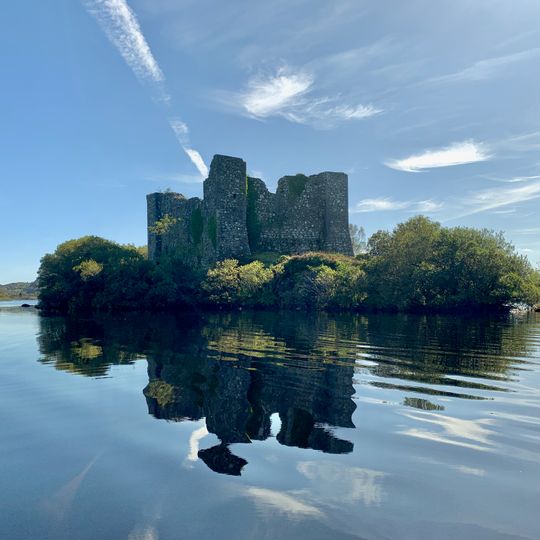
Castlekirk, Tower house ruin on an island in Lough Corrib, County Galway, Ireland
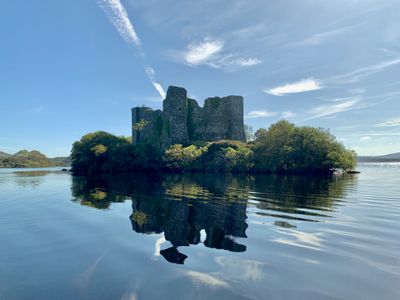
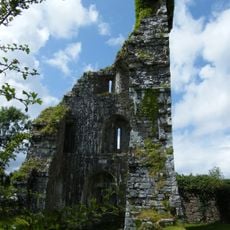
Castlekirk is a roofless tower house of grey stone blocks rising from a tiny 0.18-hectare island in the northwest corner of Lough Corrib, on the approach to Maum. Its crumbling walls are overgrown with ivy; a tall jagged section on the left and a rounded blocky mass on the right are separated by a gap in the upper wall. The rocks slope abruptly into the water on all sides.
Castlekirk was built early in the 12th century by the sons of Ruaidrí na Saide Buide (d. 1118), aided by William FitzAldelm, and is one of Ireland's oldest mortared castles. In 1225 the Lord Justice Sir Edmond Butler forced Odo O'Flatherty to surrender it to Aedh Ua Conchobair, King of Connaught. Fedlimid Ua Conchobair knocked it down in 1233; it was held until Cromwellian soldiers took it in 1654.
The castle's other name, Hen's Castle, comes from Gráinne Ní Mháille: at sixteen she married Dónal an-Chogaidh O'Flaherty, nicknamed 'the Cock' for his aggression, and she became 'the Hen'. After his murder she defended the stronghold so fiercely that it took her name.
Reaching the castle requires a boat journey across the lake, so visitors should plan accordingly depending on weather and water conditions. The site is protected as a National Monument, so access may have restrictions or seasonal limitations.
Lady Jane Wilde, Oscar Wilde's mother, recorded the island's folklore in her 1888 work "Speranza": strange lights flit through the ruin, and at certain midnights boats of men dressed in green with red sashes row around it until a cock crows, then vanish as children's cries are heard, a sign the Sidhe have taken a child.
The community of curious travelers
AroundUs brings together thousands of curated places, local tips, and hidden gems, enriched daily by 92,748 contributors worldwide.