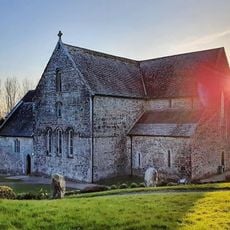
Castle Carra, Medieval hall house on Lough Carra, County Mayo, Ireland.
Castle Carra is a rectangular hall house, not a tower, standing on the east bank of Lough Carra 2.5 km west of Carnacon. Its 13th-century walls were extended in the 15th century by the MacEvilly family, who added the plinth, bawn, outbuilding and gateways. A circular flanker with gunloops facing inland was built into the bawn after the 1570s.
Castle Carra was built in the 13th century by Adam de Staunton, an Anglo-Norman subject of the de Burgo family. In the 15th century the MacEvilly family, a Gaelicized branch of the de Stauntons, added the plinth, bawn, outbuilding and gateways. The castle was surrendered to the Crown in the 1570s and granted to Captain William Bowen, who strengthened the bawn with a circular flanker with gunloops facing inland.
The MacEvilly family, a Gaelicised branch of the de Stauntons, added the plinth, bawn, outbuilding and gateways in the 15th century. The castle stayed with an Irish clan independent of England for almost 300 years, and the state now owns the National Monument.
The ruins are located west of Carnacon and reached via a country lane that approaches from the lakeside. Visitors should wear sturdy shoes because the remains are uneven and water is nearby.
Castle Carra stands on the edge of Black Hole, the deepest part of Lough Carra, right beside the east bank. The name is a lake-depth label rather than a structure, and the hall house was sited directly on this drop-off. The plinth, bawn, outbuilding and gateways added in the 15th century by the MacEvilly family survive in part.
The community of curious travelers
AroundUs brings together thousands of curated places, local tips, and hidden gems, enriched daily by 92,729 contributors worldwide.