Tomb of Nicanor, Ancient burial cave on Mount Scopus, Jerusalem, Israel
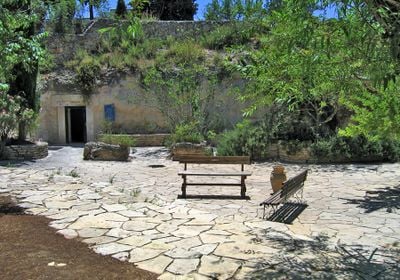
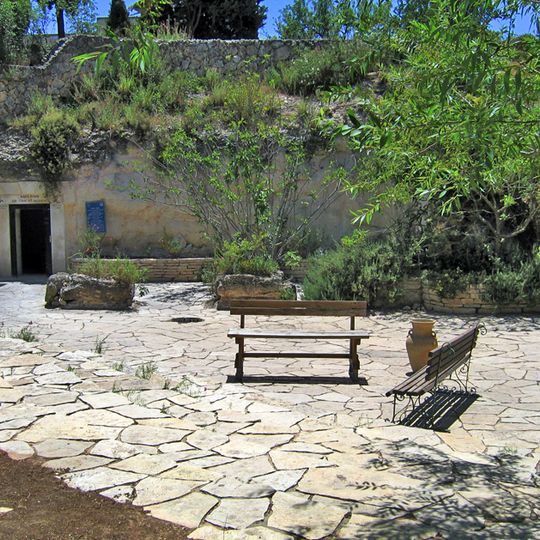
The Tomb of Nicanor is a burial complex cut into the chalk rock of Mount Scopus, in the National Botanic Garden of Israel on the Hebrew University campus. A rectangular hewn courtyard with seating corners leads to a porch whose two square pillars were built of ashlar stones rather than carved from the rock. Four burial halls with loculi open off the porch, and a fifth hall opens separately on the courtyard's eastern side.
The cave was cut in the mid-1st century CE, in the Second Temple period, and its plan and finds date it to about that time. Byzantine pottery at the bottom of the courtyard shafts and two crosses engraved on the wall of the main room show the cave was still in use in the Byzantine period. In 1934 Leon Pinsker's remains were reburied in hall 2, and Menachem Ussishkin, buried there in 1941, was the last person interred.
Nicanor came from a wealthy Alexandrian family and earned mention in ancient texts for donating bronze doors to the Second Temple. His name appears on inscriptions that tell of his status in the ancient Jewish community.
The cave is inside the National Botanic Garden of Israel on the Mount Scopus campus of the Hebrew University, so access follows the garden's opening arrangements. The burial chambers themselves are closed off; the hewn rectangular courtyard, its seating corners and the five entrances of the rock facade are what can be seen. The courtyard is paved with irregular light stone slabs and has wooden benches.
The site was discovered by chance in 1902 by a groundskeeper and contained seven ossuaries bearing bilingual Hebrew and Greek inscriptions. These finds reveal the multicultural nature of ancient Jewish society.
The community of curious travelers
AroundUs brings together thousands of curated places, local tips, and hidden gems, enriched daily by 94,601 contributors worldwide.