Herod's Gate, City gate in the Muslim Quarter, Old City of Jerusalem, Palestine
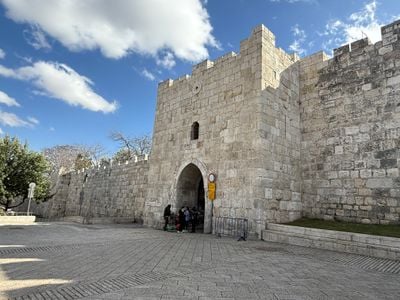
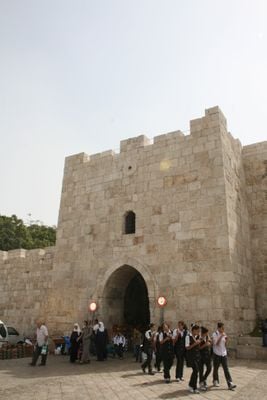
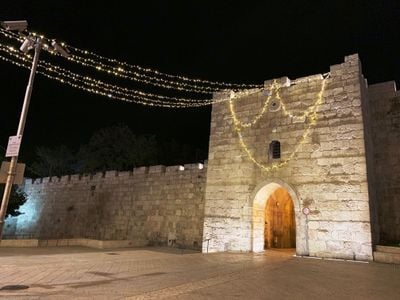
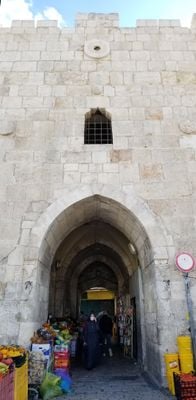
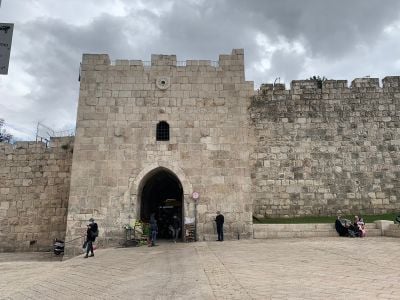
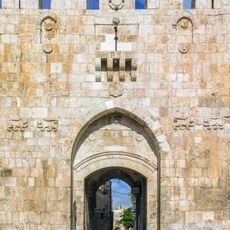
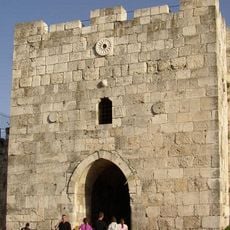
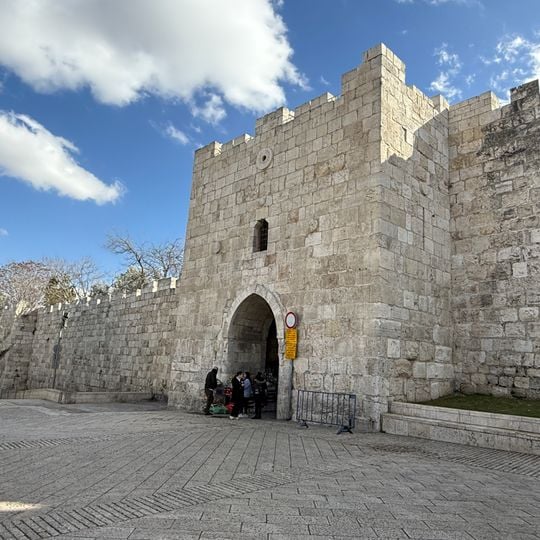
Herod's Gate is a gatehouse in Jerusalem's northern Old City wall, built of pale rectangular stone blocks. Its facade rises from a wide base to stepped crenellations, with a pointed archway at the base, a small narrow window above it, and a circular stone medallion set below the battlements. It opens into the Muslim Quarter.
Suleiman the Magnificent built the wall tower in the 1530s with a small wicket gate in its eastern side wall, rarely opened. By 1875 the Ottomans opened a new gate in the tower's northern frontal wall facing Sultan Suleiman Street, to serve new neighborhoods growing north of the Old City, and closed the original lateral gate.
The Arabic name Bab az-Zahra comes from as-Sahira, the hill and cemetery across the road where pilgrims to Mecca were buried; a mispronunciation turned it into "Flowers Gate". The Hebrew name Sha'ar HaPrakhim follows that misnomer, though popular lore links it to the stone rosette on the tower. The Christian name Herod's Gate rests on a tradition placing Herod Antipas's palace nearby.
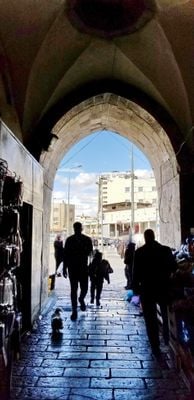
The gate opens in the northern frontal wall of its tower, facing Sultan Suleiman Street, a short distance east of Damascus Gate. The original lateral entrance in the tower's eastern wall was closed when the frontal opening was made. Inside, a small fruit and vegetable market and the Indian Hospice (Zawiyat al-Hunud) stand near the passage.
Archaeological digs near the gate uncovered nine distinct layers of civilization stretching from the Iron Age to the Ottoman period. These layers reveal how this strategic entrance was rebuilt and used across different eras.
The community of curious travelers
AroundUs brings together thousands of curated places, local tips, and hidden gems, enriched daily by 92,633 contributors worldwide.