Damascus Gate, City gate in the Old City of Jerusalem, Palestine
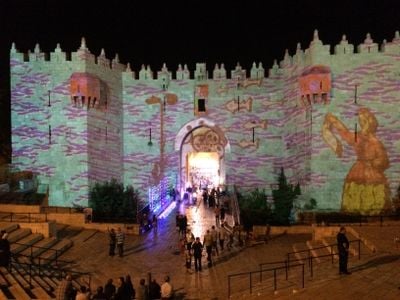
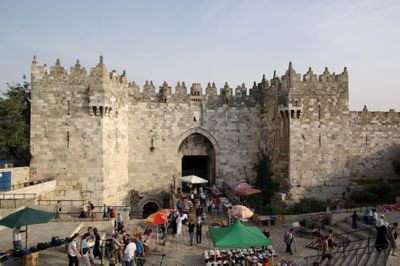
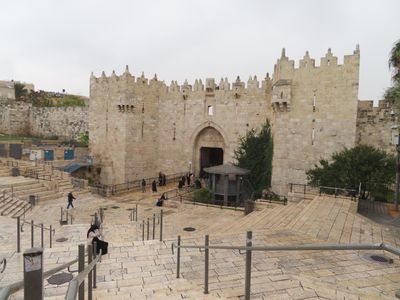
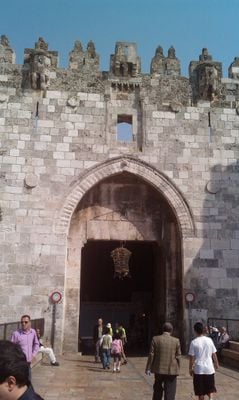
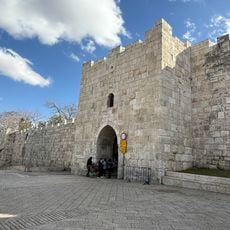
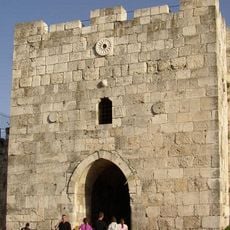
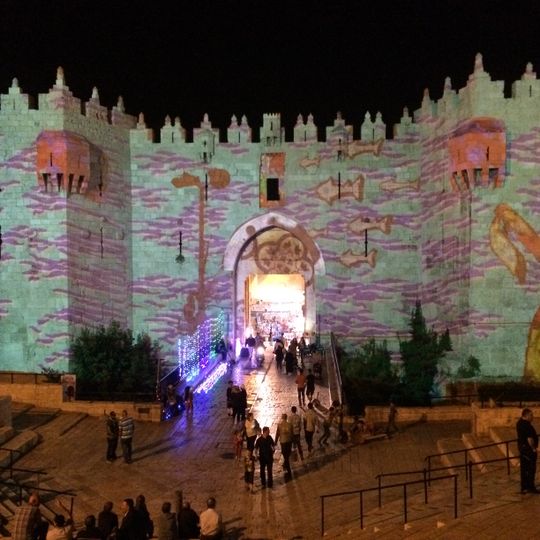
The Damascus Gate is a city gate in the northwest wall of Jerusalem's Old City, built of pale grey and tan stone blocks. A wide pointed archway is flanked by two projecting rectangular towers, each carrying a small box-like balcony on corbels near its top. Above the arch rises a crenellated parapet with small pointed merlons, and a small rectangular opening sits over the passage.
A gate has stood on this spot since the Roman period. Hadrian's free-standing triumphal gate, dated to the 2nd century CE, was later joined to the city walls, and its lintel carries the Roman name Aelia Capitolina. The present gate was completed in 1537 under Suleiman the Magnificent, designed by the architect Darwish al-Halabi, who came from Aleppo. A two-line Ottoman naskh inscription above the gate records its construction.
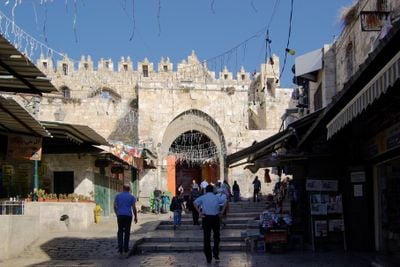
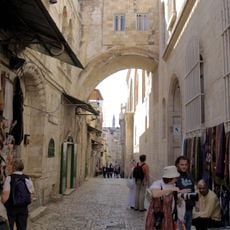
The gate's Arabic name, Bab al-Amud (Gate of the Column), recalls a 14-metre black marble column that stood in the square behind it in the Roman and Byzantine periods and appears on the Madaba mosaic map; distances from Jerusalem were measured from it. The Crusaders called it St. Stephen's Gate. Today it opens onto the bazaar of Bab Khan al-Zayt, the main street cutting the Old City from north to south, with the Christian Quarter to the right and the Muslim Quarter left and ahead.
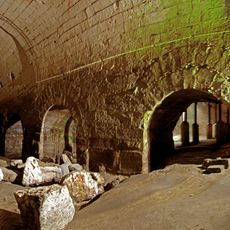
The gate is easily accessible on foot, with excavations beneath it revealing a Roman-era guardroom and staircase to the rampart top. The area is open during the day, though it can become quite crowded during peak hours.
The gate's Arabic name, Bab al-Amud, means "Gate of the Column" and recalls a 14-metre Roman column of black marble that stood in the square behind the gate, shown on the 6th-century Madaba mosaic map. The column was used to measure distances to Jerusalem and stood until the Islamic conquest.
The community of curious travelers
AroundUs brings together thousands of curated places, local tips, and hidden gems, enriched daily by 94,158 contributors worldwide.