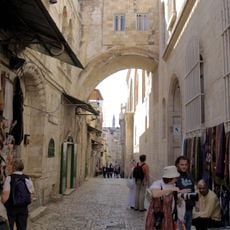
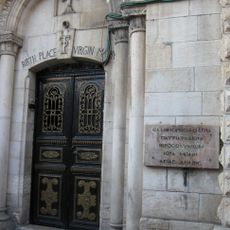
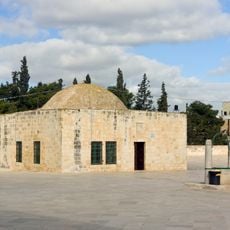
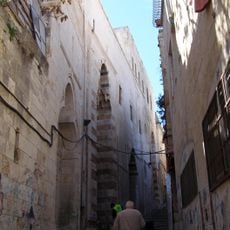
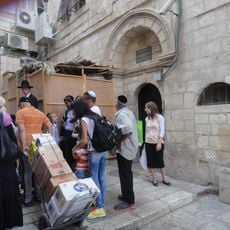
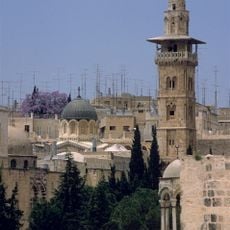
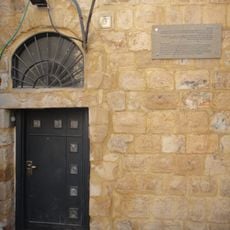
Arch of Ecce Homo, Triumphal arch on Via Dolorosa, Jerusalem, Israel.
The Arch of Ecce Homo is the central opening of a three-arched stone gate on the Via Dolorosa in Jerusalem, next to the Convent of the Sisters of Zion. The gate measures 18.94 m long, about 3.71 m wide and a reconstructed 11.2 m high. Its eastern face has four columns, one in front of each pier between the openings, and the western face holds niches for statues. The southern arch is walled into a building across the street, the northern one into the convent chapel, and rooms with two east windows and one west window sit above the arch.
The Arch of Ecce Homo was built under Emperor Hadrian, after the victory over Bar Kochba in 135 AD, as the central opening of a three-arched triumphal gate at the eastern entrance of Aelia Capitolina. Excavations in the mid-19th century revealed the gate in good condition. The archaeologist Armetta Pierotti established that it postdates the Christian event it is linked to.
The arch stands between the second and third stations of the Via Dolorosa, where Christian pilgrims walk the path associated with Jesus and pause to pray and reflect at this sacred location.
The arch spans the Via Dolorosa between the Second and Third Stations, next to the Convent of the Sisters of Zion; the northern side opening is built into the convent chapel. The southern arch has left no trace, so only the central passage is seen from the street. The west face, turned toward the city, has niches for statues.
The arch's two windows, one facing east and two facing west, may have given rise to the tradition that Pilate presented Jesus here with the words "Ecce homo". The Greek inscription on the west side, now incomplete, is read as a passage from the Gospel of Luke: "Away, away, crucify him!"
The community of curious travelers
AroundUs brings together thousands of curated places, local tips, and hidden gems, enriched daily by 92,678 contributors worldwide.