Tel Kabri, Archaeological site in Upper Galilee, Israel.
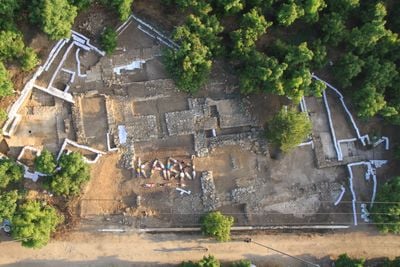
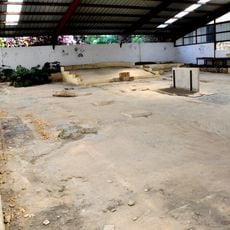
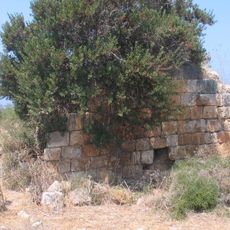
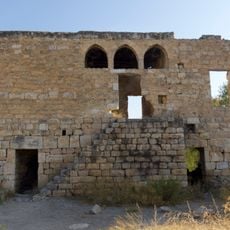
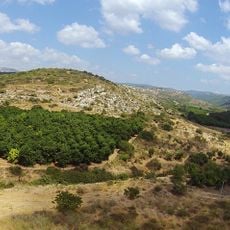
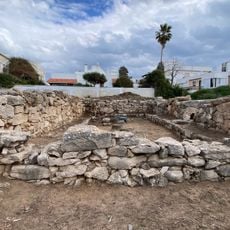
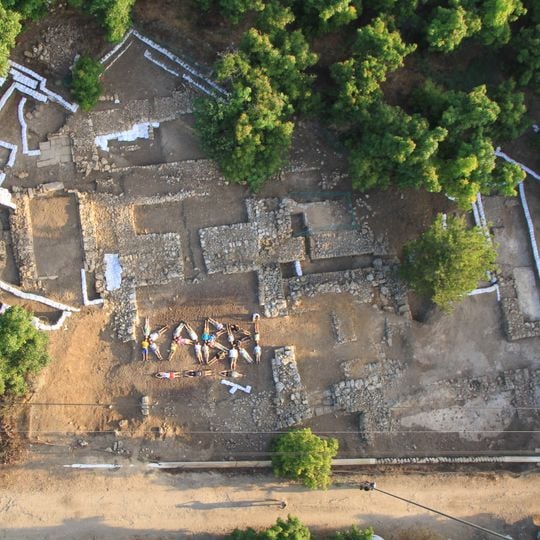
Tel Kabri is a tell on the grounds of Kibbutz Kabri in the Western Upper Galilee, less than 5 km from the sea. Its excavated Middle Bronze Age palace covers about 6,000 square metres, the largest Canaanite palace excavated in Israel as of 2014. Visitors see low dry-stone walling forming right-angled room outlines, foundations and patches of flagged paving, with some stones set vertically.
The settlement emerged in ancient times and developed across multiple civilizations, with its peak period between 2000 and 1550 BCE. During this era, it was an important center with connections to other Mediterranean regions.
The site's name comes from the Semitic root k-b-r, 'great or powerful', a reference to the four springs inside the tell: Ein Shefa, Ein Giah, Ein Tzuf and Ein ha-Shayara. The Canaanite city's own name is unknown; in the Iron Age the place was called Rehov. The palace walls carried Minoan-style paintings, the only ones found in Israel.
Tel Kabri lies on the grounds of Kibbutz Kabri, and the old Nahariya–Ma'alot road cuts through the site. The tell covers more than 200 dunams, with Ein Shefa spring inside it and Ein Giah to its north-east. The excavated palace and its wine cellar lie in the northern part of the tell, where the low stone walling and surviving paving are visible.
Beneath the palace lies an ancient wine cellar with dozens of storage vessels from around 1700 BCE, one of the oldest wine storage facilities in the ancient Near East. This discovery shows that wine was an important trade good and a sign of prosperity in this ancient society.
The community of curious travelers
AroundUs brings together thousands of curated places, local tips, and hidden gems, enriched daily by 93,383 contributors worldwide.