Byzantine church in Nahariya, Byzantine church archaeological site in Nahariya, Israel.
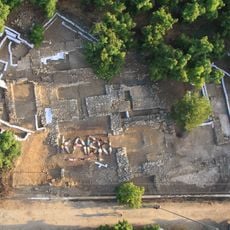
The Byzantine church in Nahariya is an archaeological site featuring a mosaic floor of roughly 500 square meters containing over 100 medallions depicting daily life scenes, animals, and Christian symbols in multiple colors. The restored mosaic surface and architectural elements remain visible under a protective structure.
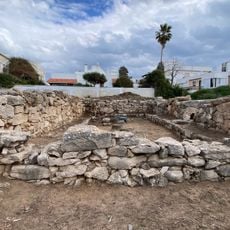
The church was dated to the 6th century, partly through a Greek inscription naming Ioannes Archiaepiscopus, archbishop of Tyre in 555 CE, whose name also appears at a church in Suhmata. It stood within Horvat Itayim, a settlement on the paved Antioch–Acre road, occupied from the Persian through the Byzantine period. Its end came in a fierce fire, after which the mosaic floor lay buried until 1964.
Twelve marble chancel panels, each 0.6 m high and 1.2–1.5 m long, carry Greek inscriptions naming the priest Leontis and his family as donors; two panels show two stags facing a central cross. On some table-leg capitals appear the letters IAP, read as the name of Ioannes, archbishop of Tyre in 555 CE, an identification supported by the same name at a church in Suhmata.
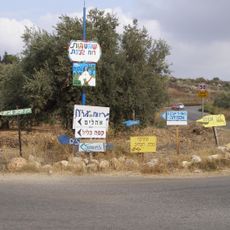
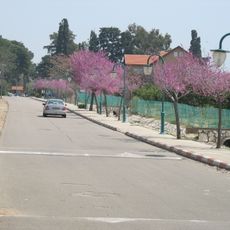
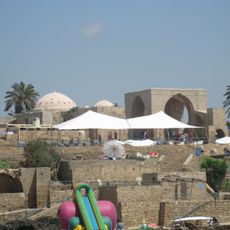
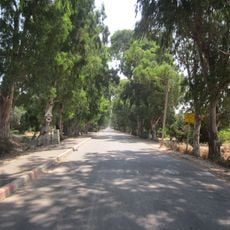
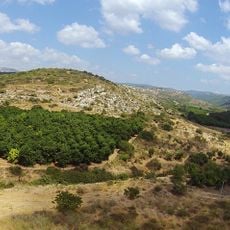
The site sits on a hill in the Giv'at Katsnelson neighbourhood, east of Route 4 and north of Route 89, between the Sharet and Katsnelson quarters. Streets leading to it are named Bielefeld Street and Bielefeld Path after the German twin city that funded the shelter. It was closed to the public for years and reopened after restoration work in 2021.
The mosaic's central rosette, 1.6 metres across, is built from geometric tesserae arranged to give a sense of depth. The floor also carries a band of 87 surviving acanthus medallions, 57 metres long and 60 cm wide, with 11 human figures among the scenes.
The community of curious travelers
AroundUs brings together thousands of curated places, local tips, and hidden gems, enriched daily by 93,472 contributors worldwide.