Rosh HaNikra Crossing, Border crossing between Israel and Lebanon at the Mediterranean coast.
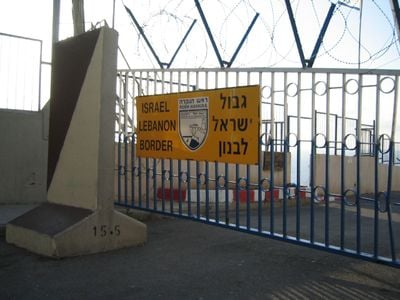
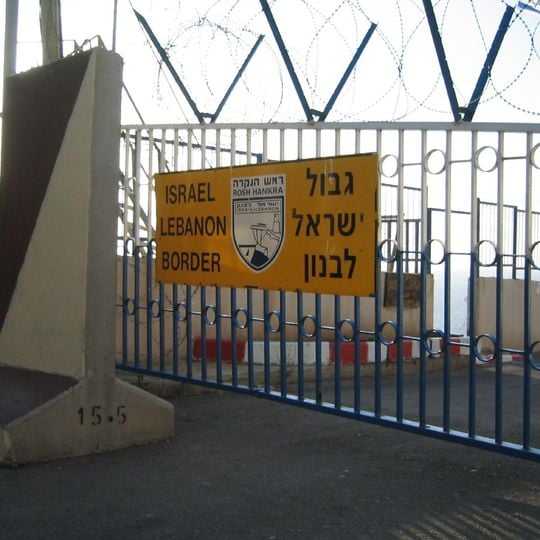
Rosh HaNikra Crossing is the only active border crossing between Israel and Lebanon, linking Rosh HaNikra with Naqoura. A blue metal gate with vertical bars and rings near the top stands between two thick concrete posts, one marked "15.5"; angled arms above it hold coils of barbed wire. A yellow sign on the gate reads "Israel", "Lebanon" and "Border" in three languages, with a shield emblem naming Rosh HaNikra.
The crossing is the only active border point between Israel and Lebanon, used mainly by UN personnel. Before the Lebanese Civil War, Lebanese civilians could enter Israel here for family visits and pilgrimage. In 2007 Israel received the body of Gabriel Dewitt, an Israeli who drowned and whose body drifted to Lebanon. In July 2008 the exchange with Hezbollah took place here.
The crossing is the only active border point between Israel and Lebanon, and its yellow gate sign reads "Israel", "Lebanon" and "Border" in three languages. Until the Lebanese Civil War, Lebanese citizens could enter Israel here for family visits and pilgrimage. Today it is used mainly by UN personnel.
The crossing is operated solely by UNIFIL and the IDF, and passage of regular tourists or visitors is forbidden. A nearby observation point faces south, overlooking the coasts of Acre, Nahariya and Mount Carmel. The blue gate with its yellow trilingual sign can be seen from outside; entry is limited to authorized personnel.
The July 2008 exchange at the crossing was not only about the two soldiers: Israel also handed over five Lebanese prisoners, among them Samir Kuntar, and the remains of 199 Lebanese and Palestinian fighters. A year earlier, in 2007, the crossing had already served for the return of Gabriel Dewitt's body, an Israeli whose corpse drifted to Lebanon.
The community of curious travelers
AroundUs brings together thousands of curated places, local tips, and hidden gems, enriched daily by 94,453 contributors worldwide.