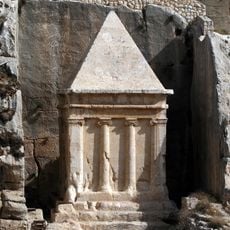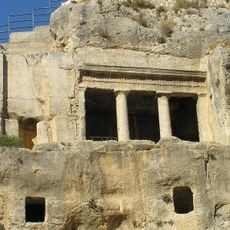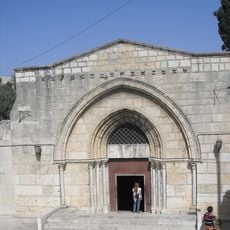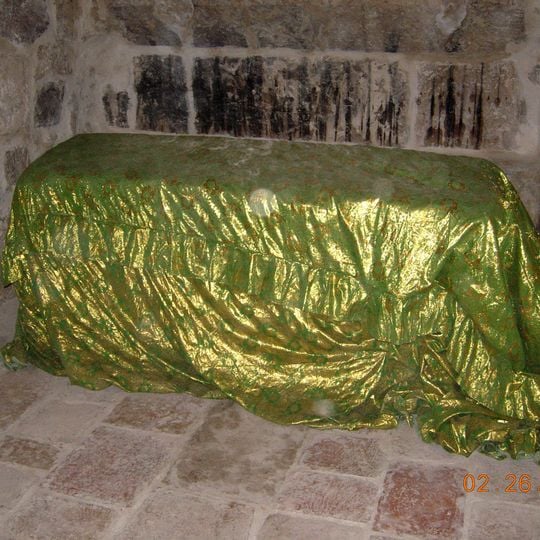
Tomb of Huldah the prophetess, Biblical cenotaph near Temple Mount, Jerusalem, Israel.
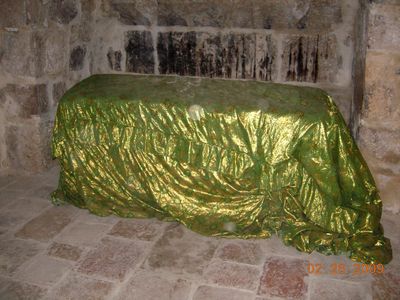
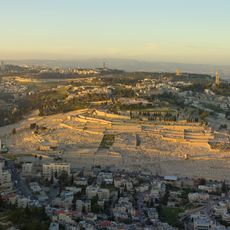
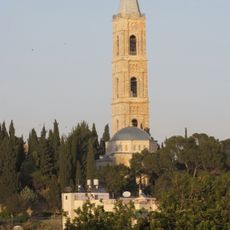
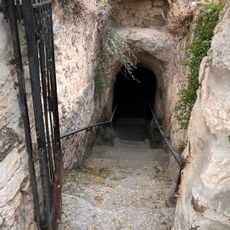
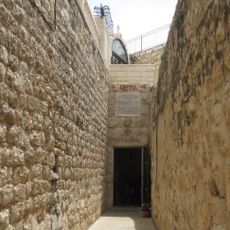
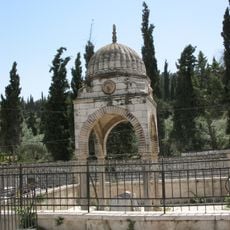
The Tomb of Huldah is a burial complex on the heights of the Mount of Olives, south of the courtyard of the Ascension Church. A dark passage leads to a small room containing a simple sarcophagus with a Greek inscription. Above the tomb stands a mosque built in the early 17th century. The tomb itself is covered by a shiny green fabric with a small repeating pattern, draped over the top and hanging in vertical folds.
According to tradition, Huldah served as a prophet in the 7th century BCE during King Josiah's reign and spoke about Jerusalem's future. Her name is linked to major religious events of that era.
The site carries three female traditions: the Jewish prophetess Huldah, the Christian penitent Pelagia of Antioch, and the Sufi mystic Rabia al-Adawiyya, after whom the street below the mosque is named. Jewish travellers such as David de Beth Hillel in 1824 noted that only Muslims could enter.
The tomb lies on the upper slopes of the Mount of Olives, south of the courtyard of the Ascension Church, reached by a dark passage that opens into a small room. A mosque built in the early 17th century stands above it; it is open to worshippers only and normally closed to visitors, so the interior is usually seen from outside.
This site is claimed by different religious traditions, with some sources connecting it to an Islamic holy woman. This overlap shows how sacred places in Jerusalem have gathered multiple meanings over the centuries.
The community of curious travelers
AroundUs brings together thousands of curated places, local tips, and hidden gems, enriched daily by 94,593 contributors worldwide.