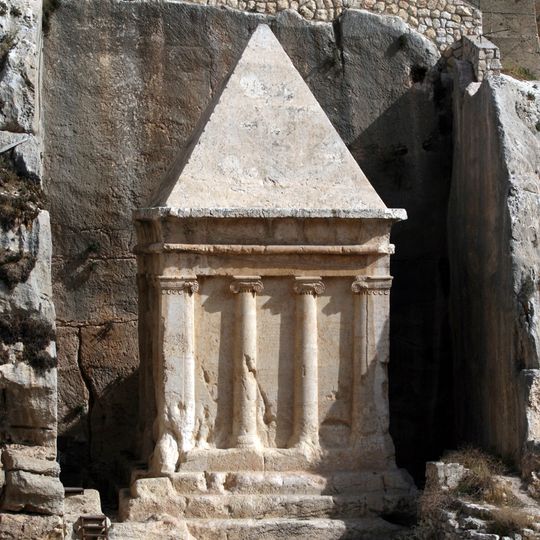
Tomb of Zechariah, Rock-cut tomb in Kidron Valley, Israel
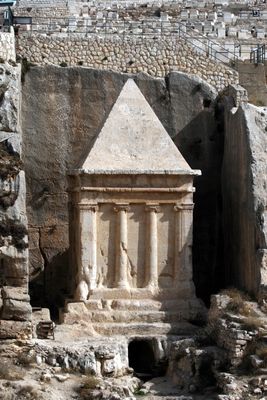
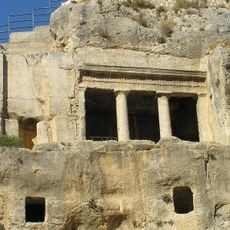
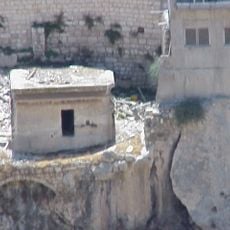
The Tomb of Zechariah is a monolith carved from the Shivta limestone of the Kidron Valley cliff, about 6 metres southeast of the Tomb of Benei Hezir. Its base is a three-stepped crepidoma; above, a square storey has two Ionic columns between two half-columns and corner pilasters, with egg-and-dart capitals. An Egyptian-style cornice carries a pyramid. Only the western facade is finely finished; the other sides are rough and unfinished.
The monument is a monolith carved from the Shivta limestone of the Kidron cliff, with no burial chamber inside. Its Ionic columns and Egyptian-style cornice link it to the nearby Tomb of Benei Hezir; scholars of funerary monuments date it to the first century BCE. A Jewish tradition first recorded by Menahem haHebroni in 1215 identifies it as the tomb of the priest Zechariah ben Jehoiada, though the absence of a chamber contradicts this.
The name comes from a Jewish tradition first recorded by Menahem haHebroni in 1215, identifying the monument as the tomb of the priest Zechariah ben Jehoiada, stoned in the Book of Chronicles. The monument has no burial chamber, and scholars date it to the first century BCE, so the link rests on tradition rather than evidence.
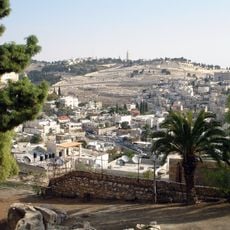
The monument sits in the Kidron Valley next to the Jewish Cemetery on the Mount of Olives and is reached by walking paths. Access is straightforward since the structure is visible from the valley floor and easily approached on foot.
The monument has no burial chamber at all; it is a monolith carved from the living rock, so scholars call it a nefesh, a memorial marker. A rock-cut passage beside it leads to the Tomb of Benei Hezir, whose inscription mentions an adjacent magnificent structure.
The community of curious travelers
AroundUs brings together thousands of curated places, local tips, and hidden gems, enriched daily by 94,040 contributors worldwide.