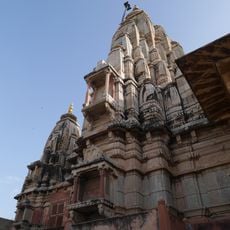
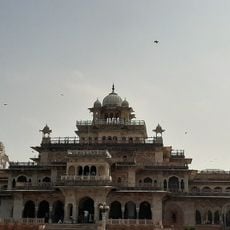
Jantar Mantar, Astronomical observatory in Jaipur, India.
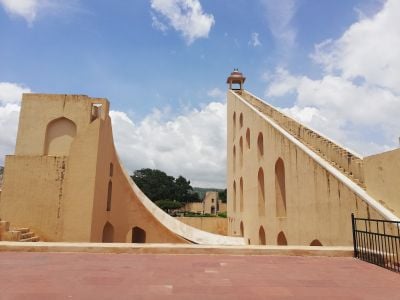
Jantar Mantar is an observatory in the heart of Jaipur featuring massive geometric structures made of local stone and marble that rise like giant sculptures into the sky. The complex holds nineteen astronomical instruments including large sundials, angle devices, and circular constructions that track celestial movements.
Maharaja Jai Singh II commissioned the observatory between 1728 and 1738 to carry out precise astronomical measurements. He gathered 23 astronomers from different traditions to design instruments that could determine celestial positions and timekeeping more accurately than methods available at that time.
The name Jantar Mantar comes from the Sanskrit yantra (instrument) and mantrana (calculate), meaning "calculating instrument". Local astronomers still use the instruments' calculations to publish Jaipur's annual panchang, and each Ashadha full moon they forecast the coming rains through the pavan dharana ritual. The instruments were built from local stone, lime, wood and metal, with astronomical scales marked on marble linings.
The site sits centrally in Jaipur and is best visited during morning hours when shadows on the instruments are clearly visible and temperatures remain more comfortable. Sturdy footwear is advisable as visitors walk over uneven stone pathways between the instruments.
The Vrihat Samrat Yantra sundial can measure time with accuracy down to two seconds and ranks among the most precise instruments of its kind from the 18th century. Its shadow moves roughly one hand width per minute across the marked scales.
The community of curious travelers
AroundUs brings together thousands of curated places, local tips, and hidden gems, enriched daily by 94,114 contributors worldwide.