Khusro Bagh, Walled Mughal garden and burial complex in Khuldabad, Prayagraj, India
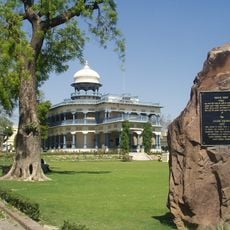
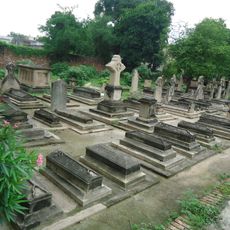
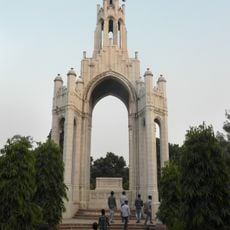
Khusro Bagh is a walled quadrangle of about forty acres near Prayagraj Junction, holding four sandstone mausoleums. The tomb of Shah Begum, designed in 1606 by Aqa Reza, is a three-storey terrace plinth topped by a large chhatri, its arabesque inscriptions carved by Mir Abdullah Mushkin Qalam. Nithar Begum's tomb, the most elaborate, stands on an elevated platform with scalloped-arch panels and painted star ceilings inside.
Shah Begum's tomb was designed in 1606 by Aqa Reza, Jahangir's court artist, after her death in 1604; Khusrau Mirza, imprisoned in the garden from 1606, was killed in 1622 and his tomb completed that year. Nithar Begum's empty mausoleum was built on her instructions in 1624-25. In 1857 the garden became headquarters of mutinous sepoys under Maulvi Liaquat Ali, who took charge as governor of liberated Allahabad, before the British retook it within two weeks.
The garden's name comes from Khusrau Mirza, Jahangir's eldest son, who was imprisoned here after his 1606 rebellion. At the main entrance, horseshoes are nailed up by visitors whose wishes, it is believed, were granted. Guava orchards inside the garden yield fruit exported abroad, and a nursery sells thousands of plants.
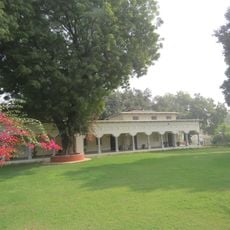
The walled garden lies in muhalla Khuldabad, close to Prayagraj Junction railway station and about 6 km from the Akbar fort at Sangam. It covers over forty acres in a quadrangle, with four gates, one on each side. The main entrance is very large and studded with horseshoes left by visitors fulfilling vows.
The complex holds the tomb of Shah Begum, designed by Aqa Reza with a three-tier structure that stands out among the other mausoleums. Remarkably, the burial site of Khusro's favorite horse is also located within the grounds.
The community of curious travelers
AroundUs brings together thousands of curated places, local tips, and hidden gems, enriched daily by 92,724 contributors worldwide.