Jorasanko Thakur Bari, Historical palace in Jorasanko, Kolkata, India.
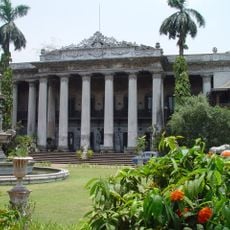
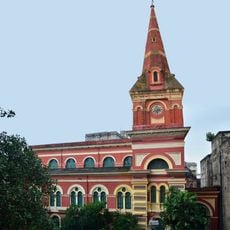
Jorasanko Thakur Bari is the Tagore family's ancestral haveli in Jorasanko, North Kolkata, built in the Dalan style of traditional Bengali architecture. Its red-painted wings with cream and white trim form an L around a grassy courtyard; the ground floor has arched openings, the upper floor rectangular windows with green louvred shutters, and small balconies with cream railings sit at the corners. The complex now houses Rabindra Bharati University and the Tagore museum.
The Tagore family built the estate in the late 18th century as their main residence in the city. Here Rabindranath Tagore was born in 1861, who later received the Nobel Prize in Literature and became a key figure in Bengali culture.
The name Jorasanko comes from two small walking bridges (sanko) on marshy land donated by the Sett family of Burrabazar. The house is the ancestral home of the Tagores, called Thakur in Bengali. Every year on Panchise Baisakh, Tagore's birthday, the university holds cultural programmes here that draw thousands of visitors.
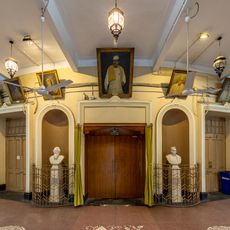
The museum occupies the first floor of Bichitra Bhavan, the red brick building Rabindranath Tagore built in 1897 west of Maharshi Bhavan. Photography is forbidden inside but permitted outdoors. In the evening a light and sound show is held on the grounds.
The museum occupies the first floor of Bichitra Bhavan, the red-brick building Rabindranath Tagore erected in 1897 west of Maharshi Bhavan. Its galleries cover the Tagore family's role in the Bengal Renaissance and the Brahmo Samaj, with separate rooms for Japan, China, Hungary and the United States, and plans for an Italy gallery.
The community of curious travelers
AroundUs brings together thousands of curated places, local tips, and hidden gems, enriched daily by 92,678 contributors worldwide.