Kenilworth Fort, British colonial fortification in Hosur, Tamil Nadu, India
Kenilworth Fort is a ruined Gothic Revival castle in Hosur, Tamil Nadu, built on the ramparts of the old Hosur fort beside its southern moat. It rose three storeys with crenellated parapets, steep spires, square corner towers, a porte-cochère, arched doorways, colonnaded verandas, slit windows below and mullioned windows above. Only rubble and the moat remain.
William Brett, Collector of Salem, built it between 1857 and 1861 on the ramparts of the old Hosur fort, to plans drawn in England. The Salem headquarters moved to Salem in 1861, so Brett and his wife never lived there; she died in Salem and is buried at St. John's Cemetery, Bengaluru. The government bought it in 1875, and it was auctioned in 1937 for 2,050 rupees.
Local accounts say the castle was built beside the southern moat of the old Hosur fort, and lime for it was burned at a hamlet on the Bengaluru road still called Sunnambu Jeevi, "lime hamlet". A memorial to collector Walton Elliot Lockhart, who is said to have died in the building, stands near the site, opposite the Hosur branch library.
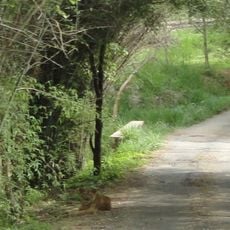
The structure survives only as a rubble mound under thorny growth beside the old southern moat, in present-day Ram Nagar, so expect no standing walls, towers or paths. Photographs of the original exterior and interiors are reportedly kept at the Sub-Collector's office in Hosur. Ask locally before setting out, as the remains are hard to find.
When a later owner levelled part of the site, a weapons store holding about 500 iron cannonballs was found. The building was auctioned by the Madras government on 29 August 1937 for just ₹2,050; the buyer T. V. Seshaiah sold it on to Varadarajulu, who stripped out and sold the wooden fittings. Only the moat survives.
The community of curious travelers
AroundUs brings together thousands of curated places, local tips, and hidden gems, enriched daily by 93,314 contributors worldwide.