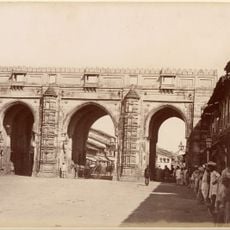
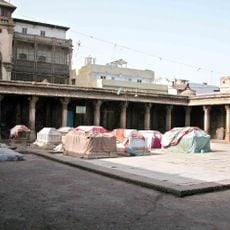
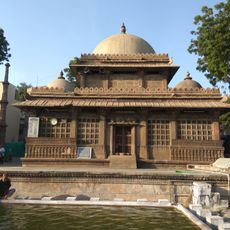
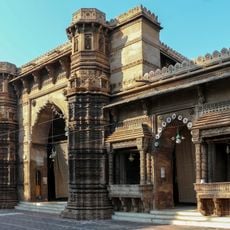
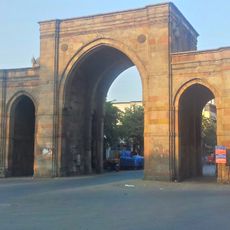
Amritavarshini Vav, Stepwell near Panchkuva Darwaja, Ahmedabad, India
Amritavarshini Vav is a sparsely ornamented stepwell near the Panchkuva Darwaja in Ahmedabad, Gujarat. It has an L-shaped plan, three storeys and a depth of more than 50 feet (about 15 metres). The bracing arches differ in shape between the two storeys and in the kuta, the pavilion tower before the well shaft.
Amritavarshini Vav was completed in 1723, according to a Devanagari and Persian inscription (Vikram Samvat 1779 / A.H. 1135) inside the stepwell. It was built by Raja Raghunathdas, diwan of Haidar Quli Khan, the subahdar of Gujarat, during his stay in the city from 1721 to 1722. The area name Panchkuva, literally five wells, comes from five wells once found there.
The stepwell's name, Amritavarshini, refers to the rain-giving power of the serpent king Vasuki in Hindu tradition, and the well was built for charitable water supply. The Devanagari and Persian inscriptions record its completion in Vikram Samvat 1779 and A.H. 1135, both pointing to 1723. The Panchkuva area takes its name from five wells once standing here.
Amritavarshini Vav stands near the Panchkuva Darwaja gate in Ahmedabad, Gujarat. It was declared a protected monument in 1969, conserved in 1999 and recharged by digging in 2004, so the shaft holds water again. The well is more than 50 feet deep across three storeys, so allow time for the descent and the climb back up.
Amritavarshini Vav was declared a protected monument in 1969 and conserved in 1999; in 2004 it was recharged by digging. Its name links it to Amrita, the nectar of immortality, and to rain, varshini. The Devanagari and Persian inscription records the year 1723 (Vikram Samvat 1779 / A.H. 1135).
The community of curious travelers
AroundUs brings together thousands of curated places, local tips, and hidden gems, enriched daily by 92,670 contributors worldwide.