Dowleswaram Barrage, Water Heritage Site and dam in East Godavari district, India.
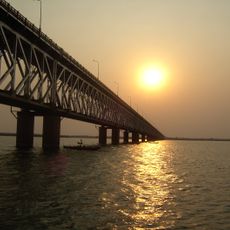
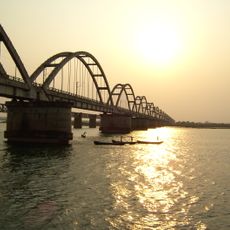
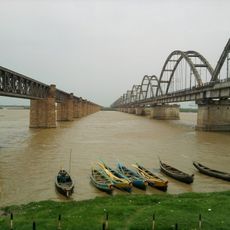
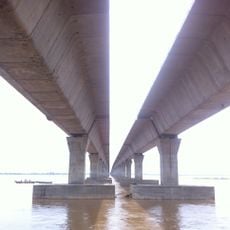
Dowleswaram Barrage, also called Sir Arthur Cotton Barrage, crosses the Godavari River in four arms with 175 bays over 3.6 km, its alignment spanning two mid-stream islands. The rebuilt structure stands 10.6 m high, with a concrete deck carrying a metal railing and lamp posts above massive rectangular piers; the nearest pier is clad in darker weathered stone blocks.
Sir Arthur Thomas Cotton began the barrage in 1847 and completed it in 1852, after the 1833 Nandana famine and the 1839 storm had devastated the Godavari delta. The 3.5 km structure, 15 feet high, was built in four sections so flood water could pass during works. It was raised in 1862-67, 1897-99 and 1936, then replaced between 1970 and 1982 by a 3.6 km barrage with 175 bays, renamed Sir Arthur Cotton Barrage.
The nearby Sir Arthur Cotton Museum displays exhibits about irrigation engineering and shows how water management transformed agriculture in this region. Visitors can see how human engineering made natural water resources work for farming communities.
The barrage deck carries a road used by small vehicles and RTC buses, so it links the Dowleswaram and Vijjeswaram banks directly. The structure is split into four arms by mid-stream islands; the Dowleswaram section alone is 1,440.5 m long with 70 gates. Look for the plaque honouring supervisor V. Veeranna, who rose to sub-engineer and received the title Rai Bahadur.
The structure was deliberately built in four separate arms to allow the river to flow freely during construction. This clever design approach meant the project could progress year after year without blocking the natural water movement.
The community of curious travelers
AroundUs brings together thousands of curated places, local tips, and hidden gems, enriched daily by 92,703 contributors worldwide.