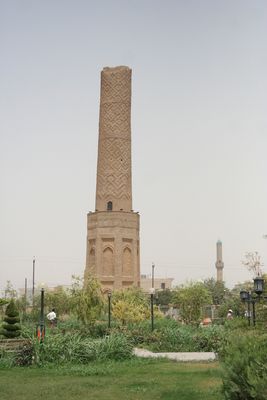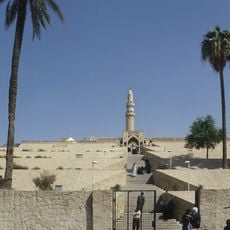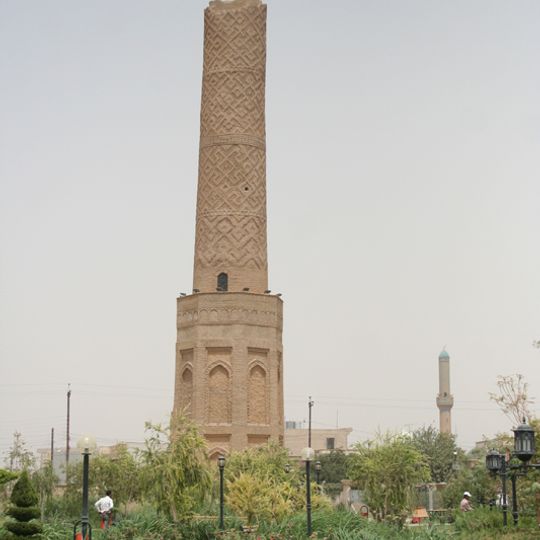
Mudhafaria Minaret, Medieval Islamic minaret in Minare Park, Erbil, Iraq.
The Mudhafaria Minaret is a cylindrical brick tower in Erbil, northern Iraq, rising from an octagonal base to a height of around 36 meters (118 feet). Its outer surface is covered in geometric brick patterns arranged in horizontal bands that give the shaft a layered, textured appearance.
The minaret was built between the late 12th and early 13th century under Prince Muzaffar Al-Din Abu Saeed Al-Kawkaboori, a ruler closely tied to Saladin. It stands as one of the few surviving monuments from Erbil's period of growth under Turkmen rule before the Mongol invasions reshaped the region.
The bands of Kufic script carved into the shaft name the builders and carry religious phrases that were meant to be read from below. This way of honoring craftsmen through inscriptions was common in medieval Islamic architecture across the region.
The minaret stands in the urban area of Erbil and can be reached on foot from the city center. A visit pairs well with a walk through the nearby historic quarter, where other old structures are within easy reach.
The tower contains a double-helix staircase with two separate entrances, one on the east side and one on the west, so that people going up and people going down never cross paths inside. This kind of two-way stair system is rare in medieval Islamic architecture and was likely designed to manage the flow of people during busy prayer times.
The community of curious travelers
AroundUs brings together thousands of curated places, local tips, and hidden gems, enriched daily by 90,809 contributors worldwide.