Nimrud, Archaeological site in Nineveh Governorate, Iraq
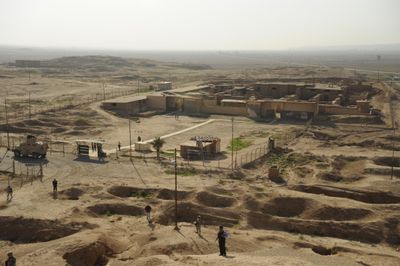
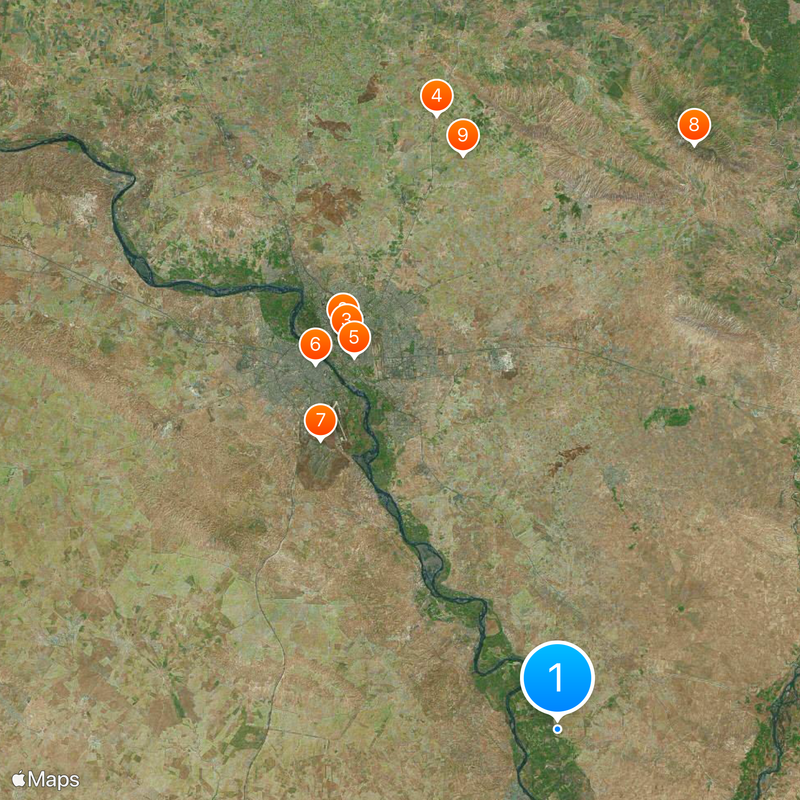
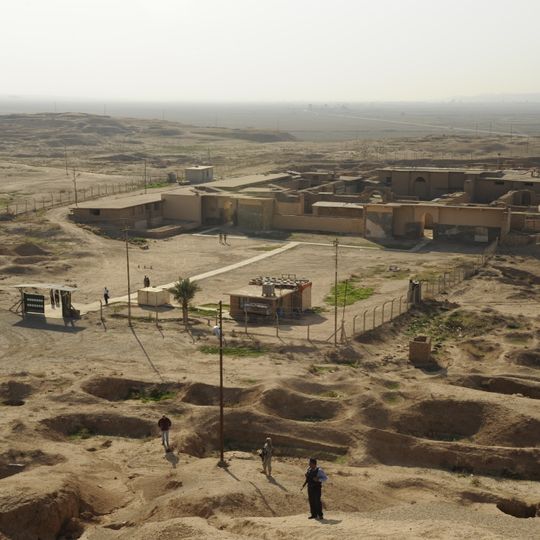
Nimrud is an archaeological mound of tan earth and eroded mudbrick in the Nineveh Plains, 30 km south of Mosul and 5 km south of Selamiyah. Its flat top holds the rectangular outlines of former structures, and on the right side stands a larger mudbrick building with a flat roof, several arched openings and a wide entryway, fronted by a low, thick wall.
Founded under Shalmaneser I (1274–1245 BC) as a trading settlement, Kalhu was rebuilt by Ashurnasirpal II as the imperial capital, serving from 879 to 706 BC. Sargon II then moved the court to Dur-Sharrukin, and the city was destroyed in 612 BC with the fall of Assyria.
The site's modern name comes from 19th-century archaeologists who linked it to the biblical Nimrod; Assyrians knew it as Kalhu. Colossal winged bulls and lions with human heads once flanked palace doorways, and examples such as the Black Obelisk of Shalmaneser III are now in the British Museum.
The site lies in a flat landscape near the river and is uneven in places due to rubble mounds and trenches. Sturdy footwear is advisable because the paths cross sand and gravel with little shade available.
Archaeologists discovered more than 600 ivory pieces hidden in a well inside a palace chamber, preserved under water for centuries. The carvings came from different cultural regions and show motifs from Egypt, Syria and Anatolia.
The community of curious travelers
AroundUs brings together thousands of curated places, local tips, and hidden gems, enriched daily by 92,563 contributors worldwide.