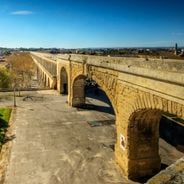
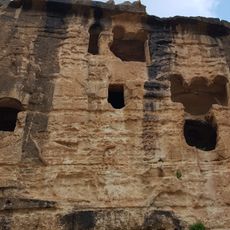
Jerwan, Aqueduct ruins in Shekhan District, Iraq
Jerwan is a locality north of Mosul whose ruins centre on an aqueduct of white limestone blocks crossing the Khenis River on stone arches. Built under Sennacherib between 703 and 690 BC, it used more than two million dressed stones and a waterproof cement to carry canal water over the valley.
The aqueduct was built by the Assyrian king Sennacherib between 703 and 690 BC as part of the Atrush Canal, which diverted water from the Khenis gorge 50 km to the north to irrigate Nineveh's gardens. It crosses the Khenis River on stone arches faced with more than two million dressed limestone blocks set in waterproof cement. Some scholars link Sennacherib's Nineveh gardens to the legend of the Hanging Gardens of Babylon.
The inscription on the aqueduct names Sennacherib as "king of the world, king of Assyria" and lists the waters he joined: the Husur, the Pulpulliya, and the springs of Hanusa and Gammagara. It records that he cut a canal to the plain of Nineveh and spanned the deep wadis with white limestone blocks. Some scholars link the Hanging Gardens of Babylon to Sennacherib's gardens at Nineveh.
Jerwan lies north of Mosul, in Shekhan District; the sources place it in Nineveh Province, while the French article puts it in Duhok Province in Iraqi Kurdistan. The site is open ground with no vegetation and few inhabitants, so bring water and sun protection. The aqueduct crosses the Khenis River bed; the 2025 Lexus filming showed the structure was unguarded, so access is unsupervised.
In 2025 a Lexus was driven across the top of the aqueduct for a commercial, which drew criticism from observers, particularly in the Assyrian community; Toyota said the aim was to embrace Iraq's cultural heritage and noted the site had been unguarded.
The community of curious travelers
AroundUs brings together thousands of curated places, local tips, and hidden gems, enriched daily by 94,065 contributors worldwide.