Macalube, Regional nature reserve in Aragona, Italy.
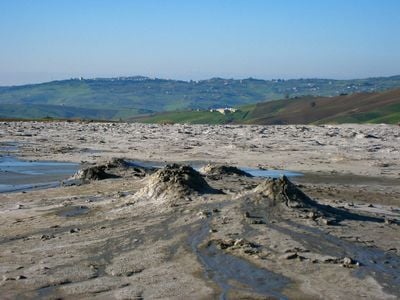
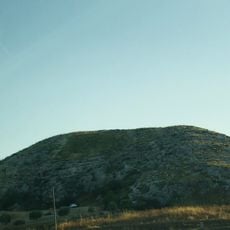
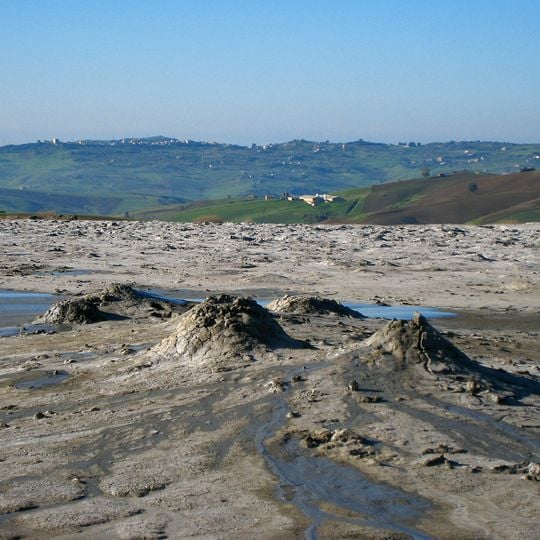
Macalube is an integral nature reserve 4 km southwest of Aragona, in the province of Agrigento, covering a broad expanse of pale grey clay. On the bare hill of the Vulcanelli, cones of wet mud about a metre high rise from the flat ground, each with a rounded, slightly cratered top and layered mud spreading into shallow pooled rings. Thin channels of wet mud wind between them, with green hills and open sky beyond.
Plato, Aristotle, Diodorus Siculus and Pliny the Elder gave the earliest descriptions of the area, and in Roman times its mud was used for rheumatic cures and beauty treatments. A local legend dates the eruptions to 1087, after a battle between Arabs and Normans, whose greyish outflow was called sangu di li Saracini. Guy de Maupassant visited in 1885 and likened the mud cones to "pustules of a terrible disease of nature".
Locals call the area Occhiu di Macalubi, "eye of Macalube", and the name Macalube comes from the Arabic maqlub, "overturning". A legend says the eruptions began in 1087 after a battle between Arabs and Normans, whose greyish mud was nicknamed sangu di li Saracini, "blood of the Saracens". Another holds that a city sank underground here after an offence to a local deity.
Access is through designated areas that require advance arrangements, while other zones remain off-limits for scientific study. Wear sturdy footwear since the ground is uneven and muddy in places.
The reserve's Italian name comes from the Arabic maqlub, "overturned", and locals call the area Occhiu di Macalubi. Guy de Maupassant, visiting in 1885, described the mud cones as "pustules of a terrible disease of nature". The site has been closed to the public since the 27 September 2014 eruption, when mud was thrown about 20 m high and two children died.
The community of curious travelers
AroundUs brings together thousands of curated places, local tips, and hidden gems, enriched daily by 93,901 contributors worldwide.