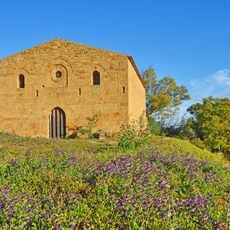
Castello Chiaramonte, Medieval castle in Favara, Italy
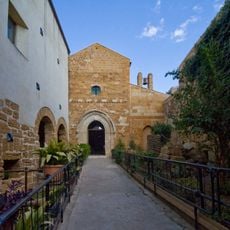
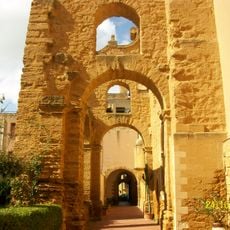
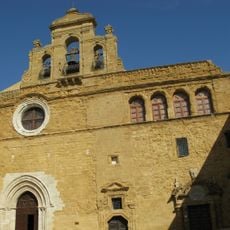
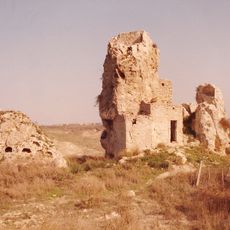
Castello Chiaramonte is a late 13th-century castle in Favara. Its square central core has residential rather than military features, with two floors: barrel-vaulted lower rooms with slit windows and an upper level. South of the palace a fortified enclosure forms an irregular octagon with the south wall, and a 1872 portal by owner Giuseppe Cafisi leads to a staircase and an external balcony.
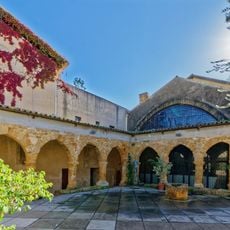
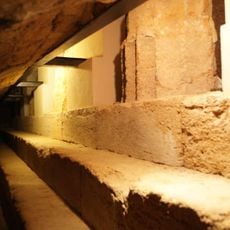
Built in the second half of the 13th century, the castle began as a military structure under Frederick II of Swabia and was later remodelled into its current form by Frederick II Chiaramonte, following Frederick II's models. It was inhabited until the early 17th century; in the 18th century the kitchens flanking the Gothic portal became a prison, with left rooms used as criminal prison and right as civil prison in the 19th century. Prisoners left numerous graffiti on the walls. A crenellated tower cited in 1611 was demolished in the 1840s for Giuseppe Cafisi's palace, and the large cistern in the centre was covered by paving.
The two ground-floor rooms flanking the now-walled Gothic portal kept their medieval names: the right one was called coquina veteri, the old kitchen, the left one simply coquina, the new kitchen, later fitted with a hood and flue. Black smoke traces still mark the walls and the entrance hall. In the 18th century these kitchen spaces became cells, and prisoners left graffiti on the plaster.
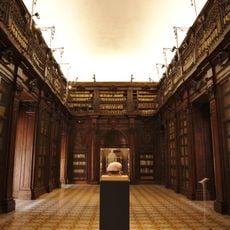
The castle stands in Favara's centre, and the surviving west stretch of the outer enclosure can be traced in the perimeter wall of Baron Antonio Mendola's library. The south side keeps the fortified quadrilateral, now irregularly octagonal where it meets the palace. The 1872 staircase ordered by Giuseppe Cafisi leads to an external balcony on the east and north sides, beside a green space still belonging to the castle.
On the south side, above the entrance portal, two coats of arms survive; one, a shield with three lozenges on the chief, belongs to the Spanish Perapertusa family. In the courtyard, a damaged heraldic relief shows a raptor's head and a hare's head, a theme of Frederick II found in no medieval Sicilian family.
The community of curious travelers
AroundUs brings together thousands of curated places, local tips, and hidden gems, enriched daily by 93,902 contributors worldwide.