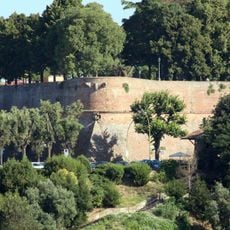
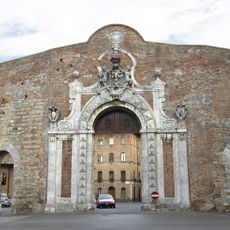
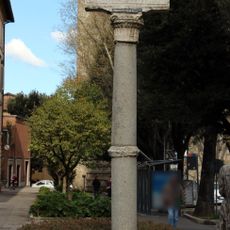
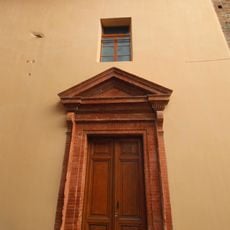
Antiporto di Camollia, Medieval fortification and city gate in northern Siena, Italy.
The Antiporto di Camollia is a medieval fortification and city gate in northern Siena featuring three connected arches. A marble bas-relief with the IHS Christogram within a sun symbol decorates the inner arch of the passage.
Built in 1270, the structure served as an additional defensive point along the Via Francigena protecting the northern entrance to Siena. In 1604, Alessandro Casolani added a stone arch on the outer facade and had it decorated by Domenico Cafaggi.
The inner passage keeps traces of frescoes applied over centuries: an Assumption of the Virgin attributed by tradition to Simone Martini, replaced by Alessandro Casolani's version of 1585-1589, then repainted by Antonio Nasini in 1685 and Giuseppe Nicola Nasini in 1699. The 1944 bombing brought Casolani's layer back to view; a 17th-century oil sketch of the Nasini work is in the Museo Diocesano.
The gate stands at the beginning of Viale Vittorio Emanuele II and serves as a reference point for visitors exploring the northern district. The structure is easy to access and there is plenty of room to view the decorations from different angles.
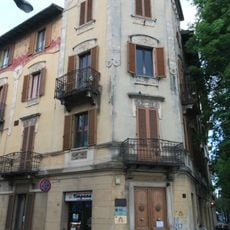
In 1911 Gilbert La Lasseur de Ranzay landed his Blériot XI-2 on the meadow between the Antiporto and the Porta di Camollia after flying from Florence, met by a crowd of at least 5,000 people; a plaque in the buildings of the later Piazza d'Armi commemorates the flight.
The community of curious travelers
AroundUs brings together thousands of curated places, local tips, and hidden gems, enriched daily by 93,581 contributors worldwide.