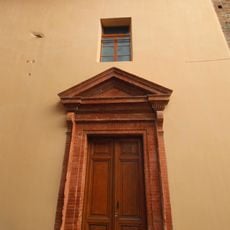
Santa Maria in Portico a Fontegiusta, Renaissance church and museum in Siena, Italy
Santa Maria in Portico a Fontegiusta is a Renaissance church on via di Fontegiusta in Siena, built 1479-1484 to a design by Cristoforo Fedeli da Como. Its square plan, forced by the narrow space against the city walls, holds three short aisles on columns with cross vaults. The brick facade is divided by pilasters and has a marble portal of 1489 by Urbano da Cortona.
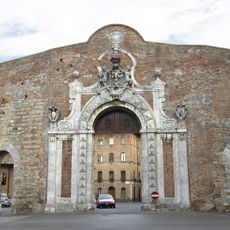
Santa Maria in Portico a Fontegiusta was built to mark Siena's victory over Florence at the Battle of Poggio Imperiale, fought at Poggibonsi on 7 September 1479. Construction followed in 1482-1484 to a design by Francesco di Cristoforo Fedeli of Como. The building absorbed the portico of the customs office that housed the miraculous Madonna di Fontegiusta, which gave the church its name. The former Porta de Pescaja city gate stood where the apse now is and was walled up when Siena restricted access in times of conflict.
The name Fontegiusta comes from the miraculous Madonna fresco kept in the portico of the customs office, which the church absorbed. In the sacristy a small museum holds relics that tradition attributes to Christopher Columbus, perhaps a student at the University of Siena. The bronze holy water stoup is by Giovanni delle Bombarde, dated 1430.
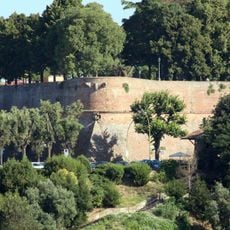
The church stands on via di Fontegiusta, just off Via Camollia near its junction with Via Paparoni, in the terzo of Camollia. The former Porta de Pescaja, also called Porta Fontegiusta, once stood where the apse is now, so the building sits against the old city walls. Space between walls and facade is tight, which is why the plan is square with three short naves.
In the sacristy a small museum holds relics that tradition attributes to Christopher Columbus, perhaps a student at the University of Siena. The collection ties the inland church to a figure of Atlantic exploration.
The community of curious travelers
AroundUs brings together thousands of curated places, local tips, and hidden gems, enriched daily by 94,009 contributors worldwide.