Triumphal arch at Castel Nuovo, Marble triumphal arch at Castel Nuovo, Naples, Italy
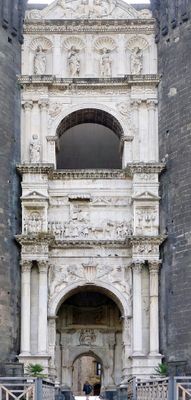
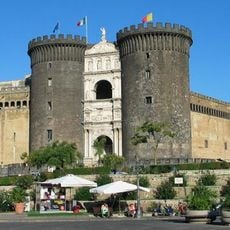
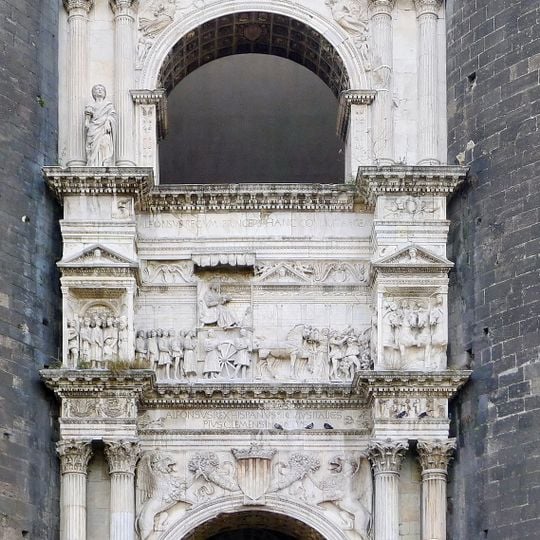
The triumphal arch at Castel Nuovo is a marble structure with two stacked arches supporting Corinthian columns. The work connects the exterior plaza to the castle's inner courtyard and stands between two large defensive towers.
Alfonso of Aragon commissioned the arch to mark his 1443 conquest of the Kingdom of Naples, and it was built in two campaigns, 1452–1458 and 1465–1471. He first planned a free-standing arch in the Roman manner, then moved it to the castle's protected entrance for fear that revolts could damage it. The frieze of the lower passage shows the king entering the city on a chariot, echoing Roman models and Frederick II's gate at Capua of 1240.
The arch's sculptures were coordinated by Francesco Laurana, a Dalmatian trained in the Venetian tradition, working with Domenico Gagini and Pietro da Milano. Laurana is credited with the figure of Justice in the niches above the upper arch and with the reliefs of the Tunisian embassy and the mounted trumpeters. The Madonna and Child he carved was later moved to the castle's chapel of Santa Barbara.
The passage allows access from the plaza directly into the castle's inner courtyard and serves as a main route for those exploring the fortress. Take time to look closely at the artworks on the facade, especially the carvings at different heights.
The reliefs of the Tunisian embassy and the mounted trumpeters are attributed to Francesco Laurana, who coordinated sculptors from several regions. He also carved the Madonna and Child, later moved to the chapel of Santa Barbara inside the castle. The frieze of the lower passage shows Alfonso entering the city on a chariot, modelled on Roman imperial processions and on Frederick II's gate at Capua of 1240.
The community of curious travelers
AroundUs brings together thousands of curated places, local tips, and hidden gems, enriched daily by 93,934 contributors worldwide.