Royal Palace, deconsecrated palace chapel in Naples, Italy
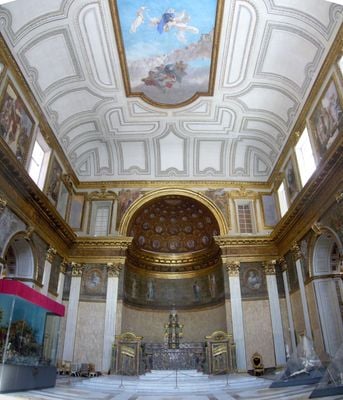
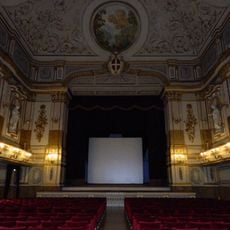
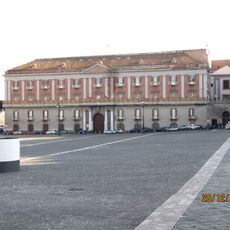
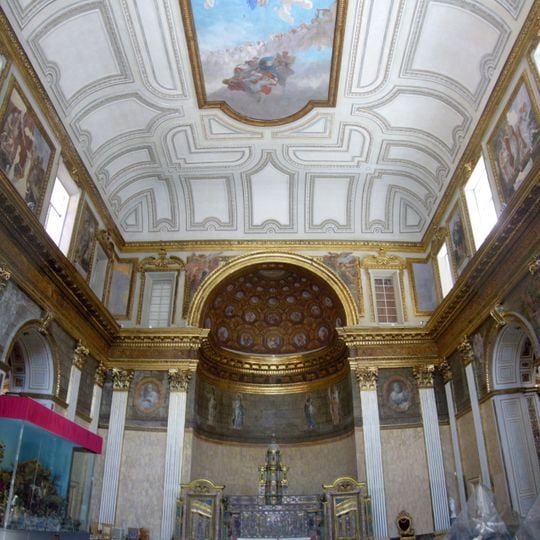
The Cappella Palatina, also called the royal chapel of the Assumption, is a deconsecrated chapel inside the Royal Palace of Naples. It has a single nave with three side chapels, white-and-gold stuccoes from the end of Bourbon rule, and a 16th-century carved wooden door in a neoclassical frame. The high altar of 1674 by Dionisio Lazzari is built of agate, onyx, lapis lazuli, amethyst and copper.
Francesco Antonio Picchiatti designed and constructed this chapel between 1643 and 1646 as part of the Spanish viceregal residence. Its creation marked a time when Naples was under Spanish rule and influenced by their architectural traditions.
The chapel was the seat of the Neapolitan musical school: maestri di cappella included Alessandro Scarlatti (1684–1702 and 1708–25), Domenico Sarro, Leonardo Leo and Giovanni Paisiello from 1787. The wooden door of the 16th century, carved by Benvenuto Tortelli, shows the star and shell, emblems of the Immaculate Conception and of Saint James the Greater.
The chapel sits inside the Royal Palace of Naples and is reached through a 16th-century carved wooden door in a neoclassical frame, moved here during Gaetano Genovese's 19th-century restoration. The sacred furnishings are arranged chronologically: 18th-century sculpture and vestments near the entrance, 19th-century pieces and relics toward the altar. The chapel was deconsecrated in 1943 and is now a museum display.
The chapel holds the Banco di Napoli presepe, a Nativity scene of nearly four hundred pieces from the 18th and 19th centuries, some modelled by Giuseppe Sanmartino and Angelo Viva. The main altar, made of agate, onyx, lapis lazuli, amethyst and copper by Dionisio Lazzari in 1674, came here in 1808 from Santa Teresa degli Scalzi.
The community of curious travelers
AroundUs brings together thousands of curated places, local tips, and hidden gems, enriched daily by 93,933 contributors worldwide.