Castle of Carini, Medieval fortification in Carini, Italy
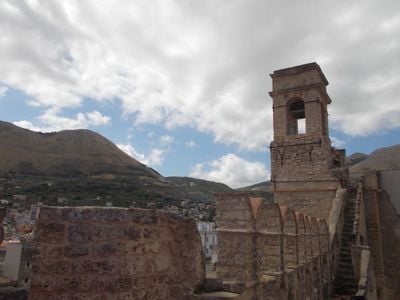
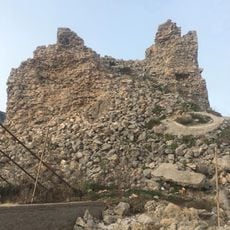
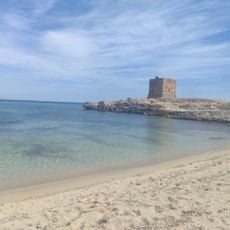
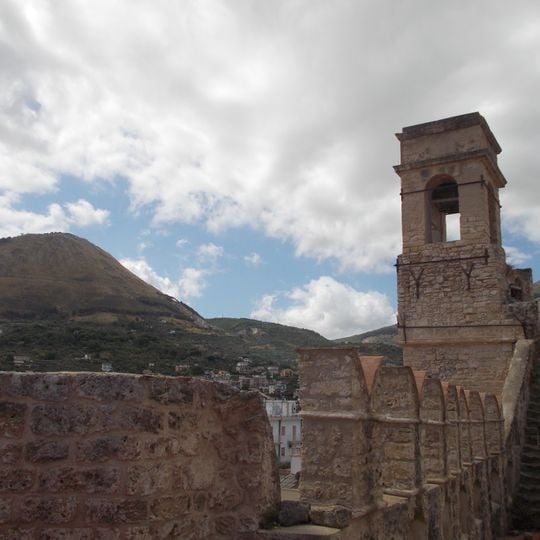
The Castle of Carini is a medieval fortress in Carini, Sicily, with walls of rough tan and grey stone. A tall square tower with an open arched belfry and putlog holes rises on one side, while a lower crenellated wall with rounded arches runs to the left. Inside, a large hall is divided by two pointed arches on a central column, and a chapel holds a wooden tabernacle from the early 1600s.
Rodolfo Bonello, a warrior in the retinue of Count Ruggero I, built the castle as the first Norman feudal lord; the medieval walls date to the 11th and 12th centuries. In 1283 it passed to the Abate family, who began converting the defensive structure to residential use. In 1397 King Martino I granted Carini to Ubertino La Grua, and in 1402 the marriage of his daughter Ilaria to Gilberto Talamanca founded the La Grua Talamanca line, which held the barony until 1812.
The chapel holds an early-17th-century wooden tabernacle framed by small Corinthian columns, with a wooden matroneum that let the family follow services from the floor above. In the festive hall, the coffered ceiling carries noble coats of arms, psalms to the Virgin and Latin mottoes such as In medio consistit virtus. A room off the hall is the one linked to Laura Lanza's meetings with Ludovico Vernagallo.
The visit runs through the ground floor, where a large hall is split by two pointed arches on a central column, then up to the noble floor. On the east side look for the Billiemi stone washbasin and the chapel with its painted trompe-l'œil. A small stair leads to the kitchen.
On the anniversary of the murder, legend holds that the print of a bloody hand appears on a wall of the room where Laura Lanza was killed. The death records of the baroness and Ludovico Vernagallo are transcribed in the historic archive of Carini's mother church.
The community of curious travelers
AroundUs brings together thousands of curated places, local tips, and hidden gems, enriched daily by 92,619 contributors worldwide.