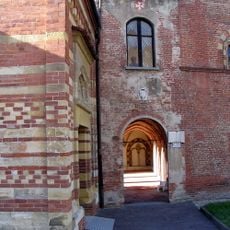
Certosa di Valmanera, Former Carthusian monastery in Asti, Italy
Certosa di Valmanera is a former Carthusian monastery in Asti with multiple buildings arranged around a rectangular cloister that creates distinct functional areas. Today the complex houses a museum and tapestry center that makes use of the historic spaces.
The site began as a Vallombrosan abbey, San Giacomo di Valleombrosa, founded by John Gualbert beneath the walls of Asti. Jacques and Barthélemy Scarambi obtained its union with the Carthusians in 1387, ratified by a bull of Clement VII in 1389. Carthusian expansion added a fishpond and about 60 giornate of vineyard and garden along the Valmanera stream. The Consulate suppressed the religious orders on 20 March 1801, and the furnishings were sacked that August.
The church, dedicated to the apostles Philip and James, kept its late 14th-century Gothic structure, with a facade modernised in the mid-18th century. Inside, three naves under pointed vaults were divided between the faithful and the monks. The great choir, carved by Paolo Sacca of Cremona with his father Tommaso and brother Imerio in 1496, held forty inlaid stalls.
The complex lies in Borgo San Pietro, in the municipal Certosa park on Asti's north-western edge at Valmanera. The entrance was on the south side, with three doorways: the central one led to the guest house, the left to a portico, the right to the service buildings. The church stood to the north, its facade facing west, preceded by a smaller second cloister.
The site houses the Arazzeria Scassa, a tapestry workshop that recreates historical designs using traditional handcraft techniques. This studio shows how the old monastery rooms remain actively used for art production today.
The community of curious travelers
AroundUs brings together thousands of curated places, local tips, and hidden gems, enriched daily by 94,030 contributors worldwide.