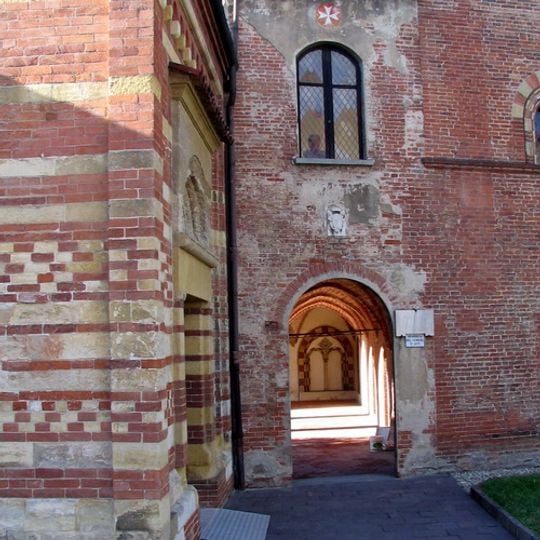
Battistero di San Pietro, Baptistry and church in central Asti, Italy
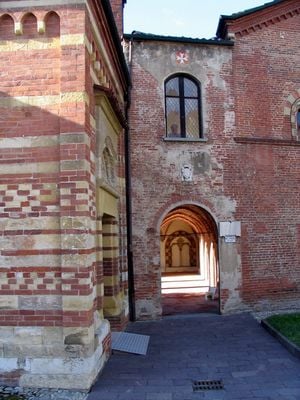
The Battistero di San Pietro is a complex of four buildings from the 12th to 14th centuries at Corso Vittorio Alfieri 6, at the eastern end of the Via Maestra in Borgo San Pietro. Its Rotonda del Santo Sepolcro is built of brick and sandstone, with an octagonal exterior, eight columns linked by round arches inside and a dome on an octagonal drum. A 16th-century marble baptismal font stands at the centre of the rotunda.
Bishop Landolfo di Vergiate began the first nucleus after 1100 as a copy of the Holy Sepulchre, so that those unable to travel to Palestine could follow a local pilgrimage. Between the 13th and 14th centuries the church grew with three wings arranged in a U around an inner courtyard. In the 15th century a square-plan building was added on the eastern side, and the complex declined in the 16th and 17th centuries during the Monferrato wars.
The name Consavia may derive from "conza-via", repairing the road, fitting a church founded by the Knights Hospitaller on the Via Romea at the city entrance. A rival claim, from the Cistercian Filippo Malabaila, credits a farmer of Castagnole Monferrato who made water spring with his spade; the historian Silicani instead links the name to the Consavia family of Castagnole, documented in the church's property deeds.
The site is easily reached in the city center and offers visitors access to a church with medieval architecture and an attached museum. The different wings of the complex are connected to each other, so you can explore the entire area well.
The complex was once the headquarters of the Gerosolimitano Priory, which managed a large network of hospitals across several northern Italian regions. This religious organization played an important role in providing medical care and support to pilgrims and travelers.
The community of curious travelers
AroundUs brings together thousands of curated places, local tips, and hidden gems, enriched daily by 94,599 contributors worldwide.