Castello di Sarmato, Medieval castle in Sarmato, Emilia-Romagna, Italy.
The Castello di Sarmato features a distinctive U-shaped brick structure surrounded by square perimeter walls with double embrasures, a moat, and an angular tower with internal donjon enclosing the inner ward.
The castle was built around the year 1000, possibly on a Sarmatian site and certainly on a Lombard garrison. Its first certain date is 1216, when Milanese and Piacenza militias gathered here before taking the Ghibelline forts near Rovescala. In 1270 troops of Ubertino Landi, lord of Bardi, attacked and badly damaged it. In 1441 Filippo Maria Visconti granted Sarmato as a county to Alberto III Scotti Douglas; the Scotti held it until 1819, when it passed to the Zanardi Landi counts.
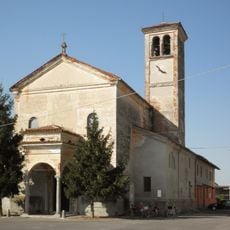
The borgo inside the walls holds the Oratorio di San Carlo Borromeo, one of the few surviving examples in the Piacenza area of devotion to the Milanese saint. Pilgrims resting at the old hospice, the Casino, carried the story of Saint Roch of Montpellier across Christendom; legend places his plague illness in a hut or cave in the woods a few dozen metres from the castle.
The walled borgo is entered from the south through a merloned ravelin with two arches, one for pedestrians and a pointed one for vehicles, once fitted with drawbridges. The east gate now houses the town hall, while the west gate, the Rocchetta, held the military garrison. Inside, two perpendicular streets lead past the houses, the castle and the Oratory of San Carlo Borromeo.
The pentagonal signalling turret beside the main block is irregular in plan and is described as the only one of its kind in the defensive architecture of the Duchy of Parma and Piacenza. Inside the walls the counts Zanardi Landi laid out an Italian-style garden. The hinges of the drawbridge that once gave access to the Rocchetta are still clearly visible.
The community of curious travelers
AroundUs brings together thousands of curated places, local tips, and hidden gems, enriched daily by 92,627 contributors worldwide.