San Giovanni Battista, Catholic church in Chiavari, Italy
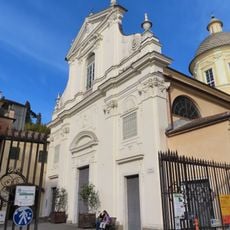
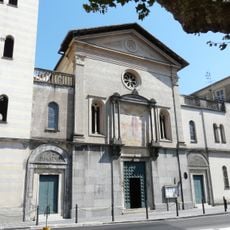
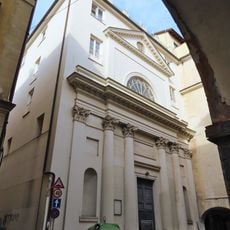
San Giovanni Battista is a church in Chiavari featuring a modern facade of white and black marbles with square portals and two statues in niches framed by dark stone pilasters. The building sits on Via Bighetti and provides access to its architectural elements and religious artworks.
A first chapel was built here in 1181 for Bardone Fieschi, archpriest of Lavagna, on land given by his Ravaschieri cousins; it was finished in 1182 with three altars. A larger three-nave church replaced it in 1462-1468 under master Bernardo Giovanni di Luma da Como. On 12 October 1623 the council ordered its demolition, and the first stone of the present church, designed by Andrea Vannone and Bartolomeo Rossi, was laid on 5 July 1624; it was consecrated on 2 March 1631.
The church is also called santuario del Cristo Nero after the black wooden crucifix moved here on 3 May 1641 from the old oratory of the Annunziata, known as dell'Arena or della Marina. Older accounts attribute its dark colour to a fire; recent studies date the sculpture to the first half of the 15th century. The altar of the Crocifisso delle rondini, formerly of Saint Bartholomew, holds it, flanked by Isaiah and Malachi carved by Luigi Brizzolara in 1900.
The church stands on Piazza San Giovanni Battista in the heart of Chiavari's historic centre, a short walk from the castle hill and Via Ravaschieri. The main portal opens on the right flank, where a 16th-century fresco of the Madonna with saints sits in the lunette. The black crucifix is in the last altar of the right transept, the Crocifisso delle rondini.
The church houses the Cristo Nero, a statue that darkened following a fire but retained its structural integrity. The sculpture has become an object of local veneration and draws the attention of many visitors.
The community of curious travelers
AroundUs brings together thousands of curated places, local tips, and hidden gems, enriched daily by 92,906 contributors worldwide.