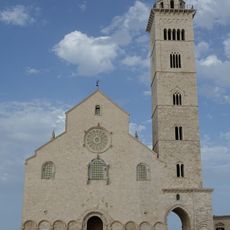
Chiesa di Sant'Andrea, Romanesque church in Trani, Italy
The church of Sant'Andrea in Trani has a compact facade that no longer preserves its original design. Its Greek-cross plan with three naves follows Byzantine models, divided by four reused granite columns ending in small apses. The hemispherical dome rises at the centre of the middle nave on four columns whose inverted shafts reveal their pagan origin.
The church was built around the year 1000 and was dedicated to Saint Basil until 1644, when it received its current title of Sant'Andrea. Greek-rite monks officiated there during that period. Its present facade is later than the original design and no longer preserves the first layout.
The church was dedicated to Saint Basil until 1644, when it was placed under Saint Andrew; Greek-rite monks officiated there before that change. A silver reliquary holds the remains of a consecrated host from the Eucharistic miracle said to have occurred around 1000, when a Jewish woman stole a host on Holy Thursday and placed it in boiling oil. Since then a penitential procession has been held each year during the Good Friday procession of the Mysteries.
The building operates as a parish office and serves as headquarters for a prayer group dedicated to Padre Pio. Visitors should be aware of annual processions that are part of the place's religious life.
The building houses one of the few surviving ancient domes in the Puglia region, preserving its original architectural features over centuries. This rare structural solution makes it a notable example of medieval craftsmanship.
The community of curious travelers
AroundUs brings together thousands of curated places, local tips, and hidden gems, enriched daily by 94,353 contributors worldwide.